
Overview
Chronic myelogenous leukemia, also called CML, is an uncommon type of cancer of the bone marrow. Bone marrow is the spongy tissue inside bones where blood cells are made. CML causes an increased number of white blood cells in the blood.
The term "chronic" in chronic myelogenous leukemia means this cancer tends to progress more slowly than severe forms of leukemia. The term "myelogenous" (my-uh-LOHJ-uh-nus) refers to the type of cells affected by this cancer.
Chronic myelogenous leukemia also can be called chronic myeloid leukemia and chronic granulocytic leukemia. It typically affects older adults and rarely occurs in children, though it can occur at any age.
Advances in treatment have improved the prognosis of people with chronic myelogenous leukemia. Most people can achieve remission and live for many years after diagnosis.
Symptoms
Chronic myelogenous leukemia often doesn't cause symptoms. It might be detected during a blood test.
When they occur, symptoms may include:
- Bone pain.
- Bleeding easily.
- Feeling full after eating a small amount of food.
- Fatigue.
- Fever.
- Weight loss without trying.
- Loss of appetite.
- Pain or fullness below the ribs on the left side.
- Excessive sweating during sleep.
- Blurry vision caused by bleeding in the back of the eye.
When to see a doctor
Make an appointment with your health care provider if you have any persistent symptoms that worry you.
Causes
Chronic myelogenous leukemia happens when something causes changes to the bone marrow cells. It's not clear what starts this process. However, doctors have discovered how it progresses into chronic myelogenous leukemia.
A new chromosome develops
Human cells typically have 23 pairs of chromosomes. These chromosomes hold the DNA that contains the instructions that tell the cells what to do. In people with chronic myelogenous leukemia, the chromosomes in the blood cells swap sections with each other. A section of chromosome 9 switches places with a section of chromosome 22. This creates an extra-short chromosome 22 and an extra-long chromosome 9.
The extra-short chromosome 22 is called the Philadelphia chromosome. It is named for the city where it was discovered. The Philadelphia chromosome is present in the blood cells of 90% of people with chronic myelogenous leukemia.
The Philadelphia chromosome creates a new gene
Genes from chromosome 9 combine with genes from chromosome 22 to create a new gene called BCR-ABL. The BCR-ABL gene tells the blood cells to produce too much of a protein called tyrosine kinase. Tyrosine kinase promotes cancer by allowing certain blood cells to grow out of control.
The new gene allows too many diseased blood cells
Blood cells begin growing in the bone marrow. When the bone marrow functions correctly, it produces immature cells, called blood stem cells, in a controlled way. These cells then mature and specialize into the red cells, white cells and platelets that circulate in the blood.
In chronic myelogenous leukemia, this process doesn't work properly. The tyrosine kinase allows too many white blood cells to grow. Most or all of these cells contain the Philadelphia chromosome. The diseased white blood cells don't grow and die like they should. The diseased white blood cells build up in huge numbers. They crowd out healthy blood cells and damage the bone marrow.
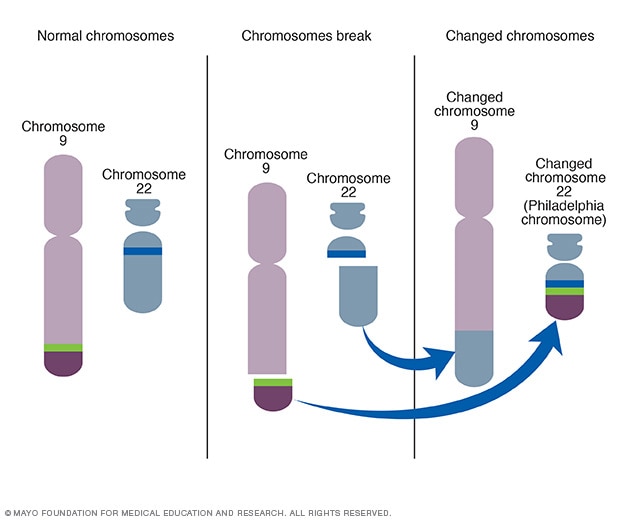
How the Philadelphia chromosome forms
Most people with chronic myelogenous leukemia have a chromosome called the Philadelphia chromosome inside their blood cells. Typical cells each contain 23 pairs of chromosomes that are made of DNA. DNA holds the instructions for every cell in the body. The Philadelphia chromosome forms when chromosome 9 and chromosome 22 break and exchange parts. This creates a short chromosome 22 and a new combination of instructions for the cells. These new instructions can lead to the development of chronic myelogenous leukemia.
Risk factors
Factors that increase the risk of chronic myelogenous leukemia include:
- Older age. CML is more common in older people than in children and teens.
- Being male. Men are slightly more at risk of developing CML than are women.
- Radiation exposure. Radiation therapy for certain types of cancer has been linked to CML.
There's no way to prevent chronic myelogenous leukemia. If you get it, there's nothing you could have done to prevent it.
Family history is not a risk factor
The gene change that leads to chronic myelogenous leukemia isn't passed from parents to children. This change is believed to develop after birth.