
Diagnosis
In most cases, biliary atresia cannot be detected before birth. Routine prenatal ultrasounds usually look healthy. On rare occasions, a small or missing gallbladder may be seen, but this is not enough to confirm a diagnosis.
Diagnosing biliary atresia in a newborn involves a combination of lab tests and imaging studies. It is usually confirmed through a liver biopsy or a special imaging test done during surgery under anesthesia, called intraoperative cholangiography. The process usually begins when a baby's jaundice lasts longer than two weeks. While jaundice is common in newborns, persistent yellowing of the skin and eyes can be a sign that bile is not flowing properly out of the liver. Healthcare professionals use several tools to figure out whether biliary atresia is the cause.
Blood tests
One of the first steps is checking the baby's bilirubin levels through a blood test. Bilirubin is a yellow substance made when the body breaks down old red blood cells. The liver usually turns it into a water-soluble form, called direct or conjugated bilirubin. This bilirubin is released into bile and leaves the body through the intestines.
In babies with biliary atresia, the bile ducts are blocked, so direct bilirubin builds up in the blood. This can lead to symptoms such as jaundice, dark urine and pale stools due to the lack of bile reaching the intestines.
Healthcare professionals are especially concerned when direct bilirubin is over 1.0 milligrams per deciliter (mg/dL) after two weeks of age in babies. Other lab values that may not be within standard range include:
- Gamma-glutamyl transpeptidase (GGT), which is often very high in biliary atresia.
- Mildly elevated aspartate aminotransferase (AST) and alanine aminotransferase (ALT), which are liver enzymes.
Matrix metalloproteinase-7 testing
Healthcare professionals also may use a newer blood test called matrix metalloproteinase-7 (MMP7) to help support the diagnosis. MMP7 is a protein that is often much higher in babies with biliary atresia than in those with other liver conditions. While promising, this test is still being studied and is not yet used on its own to make a final diagnosis.
Imaging tests
Once blood tests raise concern for biliary atresia, health professionals use imaging to take a closer look at the liver, gallbladder and bile ducts to help confirm the diagnosis.
-
Ultrasound. If the lab results suggest bile flow blockage, the next step is usually an abdominal ultrasound. This test uses sound waves to create images of the liver and bile ducts. On ultrasound, signs of biliary atresia may include:
- A very small or missing gallbladder.
- A bright, cone-shaped area called the triangular cord sign near the liver, which suggests scarring where the bile duct should be.
A newer ultrasound technique looks for a short bile duct just outside the liver, called the duct at the hilum. If this duct isn't seen, it may point to biliary atresia. The test can be done while the baby is feeding and takes only a few minutes. In one study, this approach accurately identified all infants with biliary atresia and most without the disease. Results from this study suggest that this approach may reduce the need for more-invasive tests such as liver biopsy or intraoperative cholangiogram.
-
Hepatobiliary iminodiacetic acid (HIDA) scan. This imaging test shows how well bile moves from the liver into the small intestine. A small, safe amount of radioactive tracer is given through an IV, and a special camera tracks how the liver and bile ducts handle it.
If the tracer doesn't reach the intestine, it suggests that bile isn't flowing as it should. But that can happen in several liver conditions, not just biliary atresia. Likewise, some babies with biliary atresia may have a typical HIDA scan. Because of this, the HIDA scan is used together with blood tests, ultrasound and sometimes a liver biopsy to help medical professionals understand the cause of a baby's jaundice.
Liver biopsy
If imaging and lab results suggest biliary atresia, healthcare professionals may recommend a liver biopsy under anesthesia. This involves taking a very small sample of liver tissue to examine under a microscope. In biliary atresia, the biopsy often shows:
- Extra growth of small bile ducts, called bile duct proliferation.
- Thick bile trapped in the ducts, known as bile plugs.
- Early scarring of the liver, called fibrosis.
These findings suggest bile duct blockage, most commonly biliary atresia. But they also can be seen in other conditions.
Intraoperative cholangiogram
If imaging and biopsy suggest biliary atresia but the diagnosis is still uncertain, healthcare professionals may recommend a minor surgery. During this procedure, surgeons perform an intraoperative cholangiogram. This involves injecting dye directly into the bile ducts and taking X-rays. If the dye does not flow into the intestines, this confirms the diagnosis.
In the same surgery, healthcare professionals may go ahead with treatment by performing Kasai surgery to help drain bile from the liver.
Other conditions that may look like biliary atresia
Several other conditions can cause jaundice or pale stools in infants, so it's important for medical professionals to rule them out:
- Neonatal hepatitis. This is liver inflammation caused by infection or other factors. It can cause jaundice and dark urine but usually doesn't block the bile ducts. Most infants with this condition do not need surgery and may improve over time or with specific treatment.
- Alagille syndrome. This is a genetic condition that causes the liver to form too few bile ducts. It can look similar to biliary atresia but usually includes other signs such as heart defects, butterfly-shaped spine bones and a distinct facial appearance. Alagille syndrome is managed differently and doesn't respond to bile duct surgery.
- Choledochal cyst. This condition occurs when part of the bile duct is widened or forms a cyst. It can block the normal flow of bile and cause jaundice. Unlike biliary atresia, the bile ducts are still present, and surgery can correct the blockage.
- Alpha-1 antitrypsin deficiency. This is a genetic condition that affects how the liver processes a certain protein. When this protein builds up in the liver, it can cause inflammation and jaundice in infants.
- Progressive familial intrahepatic cholestasis (PFIC). PFIC is a rare inherited condition that prevents bile from flowing out of the liver as it should. Babies with PFIC may have jaundice, poor growth and itching as the disease progresses.
Treatment
Babies with biliary atresia need early treatment to protect their livers and help bile drain properly. Treatment usually involves surgery. For some babies, treatment is a liver transplant.
Surgery
The Kasai procedure, also called a hepatoportoenterostomy, is the procedure of choice for biliary atresia. This operation creates a new pathway for bile to leave the liver by connecting the baby's intestine directly to the liver, bypassing the blocked bile ducts.
To perform the Kasai procedure:
- The surgeon begins by removing the damaged bile ducts located outside the liver.
- Then a section of the baby's small intestine is carefully connected directly to the surface of the liver. This new pathway allows bile to drain straight from the liver into the intestine, helping it leave the body as it typically would.
The Kasai procedure works best when it is done early, ideally before 60 days of age. Performing the surgery within this window gives the baby the best chance of restoring bile flow and avoiding or delaying a liver transplant.
Even when the surgery is successful, children still need regular follow-ups. Over time, most children develop liver damage and require additional treatment, including the possibility of a liver transplant later in life.
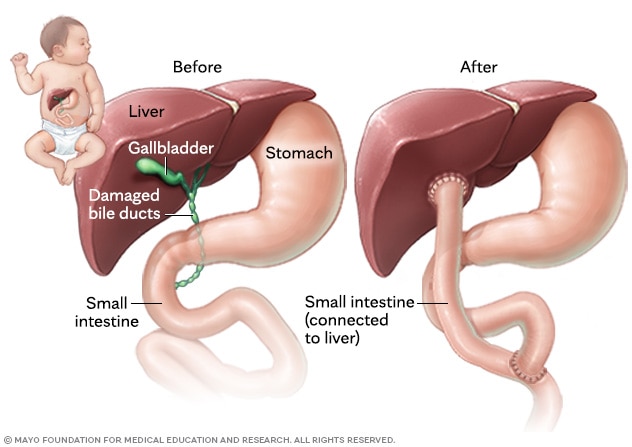
Kasai procedure
Before surgery, the bile ducts outside the liver are damaged or blocked, preventing bile from draining. After the Kasai procedure, a loop of the small intestine is connected directly to the liver to allow bile to drain into the intestine.
Liver transplant
Around 60% to 80% of children with biliary atresia eventually need a liver transplant. A liver transplant may be needed:
- If the Kasai procedure fails to restore bile flow.
- If liver scarring continues and causes complications, such as fluid buildup, poor growth or bleeding.
- If the child develops liver failure.
Some babies need a transplant soon after diagnosis, while others may live for years before needing one. Transplants can offer a long-term solution when the liver no longer functions well.
Long-term follow-up care
Even after surgery, children with biliary atresia need lifelong follow-up with a liver care team. This includes:
- Regular lab tests to monitor liver health.
- Nutritional support, especially for fat-soluble vitamins, such as vitamins A, D, E and K.
- Monitoring for signs of liver damage or complications.
With early treatment, good nutrition and medical follow-up, many children with biliary atresia go on to live active, healthy lives.
Preparing for your appointment
If your baby has yellowing of the skin or eyes, called jaundice, that lasts longer than two weeks, pale or gray stools, or dark urine, make an appointment with your baby's healthcare professional right away. These may be early signs of a liver or bile duct condition, such as biliary atresia.
If the healthcare professional suspects biliary atresia or another liver condition, you may be referred to a specialist in children's digestive and liver diseases, such as a pediatric gastroenterologist, or to a pediatric liver or transplant center for further testing.
Because appointments can be brief, it helps to be prepared. Here's how you can make the most of your visit.
What you can do
- Ask about any pre-appointment instructions. When you schedule the visit, check whether your baby needs to fast or avoid certain foods before blood tests or imaging.
- Write down your baby's symptoms. Note when you first noticed jaundice, stool color changes or feeding issues.
- Bring key medical information. Include your baby's birth history, newborn screening results, any illnesses, and medicines and supplements, including vitamins, and their doses.
- Take another adult with you. A partner, family member or friend can help remember details and provide emotional support.
- Prepare your questions. Write them down so you don't forget anything important. List the most urgent questions first in case time runs short.
Questions to ask your baby's care team
- Could these symptoms be caused by biliary atresia?
- What tests will my baby need?
- How soon will we have results?
- If it is biliary atresia, what are the treatment options?
- How soon would surgery be needed?
- What are the possible risks or complications of surgery?
- What should we expect for recovery and long-term care?
- Should we see a specialist or be referred to a liver center?
- Are there reliable websites, brochures or support groups for parents?
Don't hesitate to ask any other questions that come up. Understanding your baby's condition can help you feel more confident and supported.
What to expect from your doctor
Be ready to answer questions such as:
- When did you first notice your baby's jaundice or pale stools?
- Has the color of the stools or urine changed over time?
- How is your baby feeding and gaining weight?
- Have there been any recent illnesses or infections?
- Were there any complications during pregnancy or birth?
Coping and support
Learning that your baby has biliary atresia can be overwhelming. You may feel worried, sad or uncertain about what comes next. With time, many parents find ways to cope and feel more confident in caring for their child. These ideas may help:
- Learn about your baby's condition. Ask your baby's care team to explain what biliary atresia means, what tests and treatments are planned, and what to expect during recovery. Understanding the condition can help you feel more prepared and involved in your child's care.
- Lean on your support network. Family and friends can be an important source of strength. Accept offers of help, such as meals, child care or someone to talk to. Sharing your worries and small victories can make a big difference.
- Connect with others who understand. Many parents find comfort in talking with others who have gone through something similar. Ask your healthcare team about support groups for families affected by liver disease or organ transplant. National organizations such as the American Liver Foundation and Children's Liver Disease Foundation also offer online communities and information.
- Take care of yourself. Caring for a baby with a serious condition is stressful. Try to rest when you can, eat regularly and make time for breaks. You'll be better able to care for your child when you care for yourself too.