
Carrying a few extra pounds isn't uncommon, especially as people get older. But those pounds can lead to serious health risks. That's particularly true if the weight is in the form of belly fat.
Belly fat is a more dangerous fat
The trouble with belly fat is that it's not just the soft layer you can pinch under your skin, known as subcutaneous fat. Belly fat also includes a type called visceral fat, which is found deeper in your belly and wraps around your internal organs.
No matter what your overall weight is, having a large amount of belly fat raises your risk of:
- High blood pressure.
- An unhealthy amount of fat in the blood.
- Sleep apnea.
- Heart disease.
- High blood sugar and diabetes.
- Certain cancers.
- Stroke.
- Fatty liver.
- Early death from any cause.
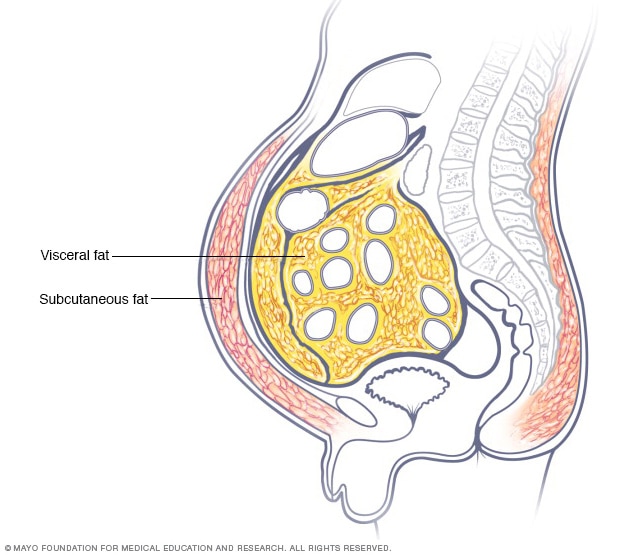
Belly fat
Subcutaneous fat is belly fat you can feel if you pinch extra skin and tissue around your middle. Visceral fat is fat that builds up deep within the abdomen in the space around the organs. Too much visceral fat is strongly linked with a higher risk of serious health conditions.
The role of age and genetics
How much a person weighs depends in large part on four things:
- Calories taken in each day.
- Calories burned off each day.
- Age.
- Genetics.
Eating and drinking more calories than you burn each day leads to gaining extra weight, including belly fat.
Getting older also plays a role. You lose muscle as you age. And muscle loss is worse if you are not physically active. Loss of muscle mass slows down how quickly the body burns calories. That can make maintaining a healthy weight harder. For example, when men are in their 50s, they need fewer calories a day than they do when they are in their 30s.
Your genes can contribute to your chances of being overweight or having obesity too. They also play a role in where the body stores fat.
Although people who smoke cigarettes tend to weigh less than people who don't, people who smoke tend to carry more of their weight as belly fat.
Alcohol and belly fat
Drinking alcohol can lead to what's sometimes called a beer belly, but beer alone isn't to blame. Drinking too much alcohol of any kind can raise your risk for belly fat. If you drink alcohol, do so only in moderation. The less a person drinks, the fewer calories, and the less likely belly fat will build up over time.
Finding your belly size
To see if your belly fat is a concern, measure your waist:
- Stand and place a tape measure around your bare stomach, just above your hip bone.
- Pull the tape measure until it fits snugly, but it doesn't push into the skin. Make sure the tape measure is level all the way around.
- Relax, exhale and measure your waist. Don't suck in your stomach as you measure.
For men, a waist measurement of more than 40 inches (102 centimeters) signals excess belly fat and a higher risk of health issues. In general, though, the greater the waist measurement, the higher the health risks.
Shrinking your middle
You can strengthen and tone abdominal muscles with crunches or other exercises focused on your belly. But doing those exercises alone won't get rid of belly fat. The good news is that visceral fat responds to the same diet and exercise strategies that can help get rid of other extra pounds and lower total body fat. Try these tips:
- Eat a healthy diet. A healthy diet involves:
- Focusing on plant-based foods, such as fruits, vegetables and whole grains.
- Choosing lean sources of protein, such as fish and low-fat dairy products.
- Limiting processed meats, as well as the saturated fat that's found in meat and high-fat dairy products, such as butter.
- Choosing moderate amounts of monounsaturated and polyunsaturated fats. They are found in fish, nuts and certain vegetable oils.
- Choose portion sizes wisely. Even when you're making healthy choices, calories add up. At home, cut down your portion sizes. In restaurants, share meals. Or eat half a meal and take the rest home.
- Replace sugary drinks. Drink water or other beverages without sugar.
- Get active. For most adults, the Department of Health and Human Services recommends moderate aerobic activity, such as brisk walking, for at least 150 minutes a week or vigorous aerobic activity, such as jogging, for at least 75 minutes a week. Strength training exercises are recommended at least twice a week. If you want to lose weight or meet specific fitness goals, you might need to exercise more. There is some evidence that high-intensity interval training (HIIT) can help reduce belly fat, as can strength training.
Losing belly fat takes effort and patience. To lose extra fat and keep it from coming back, aim for slow and steady weight loss. Ask your healthcare professional for help getting started and staying on track.
ART-20045685