Risks
Risks of a mastectomy include:
- Bleeding.
- Infection.
- Delayed healing.
- Pain.
- Pain that continues after the surgical area has healed, called postmastectomy pain syndrome.
- Formation of hard scar tissue at the surgical site.
- Numbness in the chest.
- Buildup of blood in the surgical site, called hematoma.
- Buildup of clear fluid in the surgical area, called seroma.
- Changes in the way your chest or breasts look after surgery.
- Changes in the way you feel about your body after surgery.
Breast reconstruction has additional risks. These vary depending on whether reconstruction uses an implant, tissue from another part of your body or both.
Your healthcare team checks the surgical area for problems with healing, infection and fluid buildup. The team also monitors pain and arm movement after surgery.
How you prepare
Meet with your surgeon to discuss your options
Before your surgery, you'll meet with members of your surgical team to discuss your operation. This is a good time to ask questions and to make sure you understand the procedure, including the reasons for surgery, the risks and other treatment options.
Your surgeon may talk about breast reconstruction with you. Breast reconstruction is surgery to restore shape to the breast. Several factors affect whether reconstruction can be done and when. Reconstruction may begin during the mastectomy or in a later operation. Completing it may take more than one procedure.
Breast reconstruction may involve using:
- Tissue expanders followed by implants. A temporary device called a tissue expander is placed under the skin. It is gradually filled with saline or air during follow-up visits. After the tissue has stretched and healed, the expander usually is removed and replaced with a saline or silicone implant.
- Your body's own tissue, called flap reconstruction or autologous (aw-TAH-luh-gus) tissue reconstruction.
- A combination of body tissue and a breast implant. The surgeon uses tissue from another part of the body, such as from the thigh or buttocks, along with an implant to create the breast shape.
A plastic surgeon, also called a reconstructive surgeon, performs breast reconstruction. If you're planning breast reconstruction at the same time as a mastectomy, you'll meet with the plastic surgeon before the surgery. The plastic surgeon will coordinate with the breast surgeon to be available at the time of surgery.
Before surgery, you may need to consider whether you'll have radiation therapy afterward. Radiation therapy may affect your breast reconstruction options. Some people know they will need radiation as part of their treatment plan. Others may not know whether they need radiation until after the results of the mastectomy are known. You may meet with a doctor who specializes in radiation treatment, called a radiation oncologist, before or after surgery to discuss benefits and risks.
You also may choose not to have breast reconstruction and have flat closure with a smooth, flat chest, also called aesthetic flat closure.
Preparing for your surgery
Your healthcare team will give you instructions before surgery. You may need to:
- Tell your healthcare team about any medicines, vitamins or supplements you're taking. Some medicines and supplements may affect surgery, anesthesia or healing.
- Ask when to stop certain medicines. Your healthcare team will tell you whether and when to stop glucagon-like peptide 1 (GLP-1) medicines, aspirin or other blood-thinning medicines before surgery.
- Stop smoking and using nicotine. Nicotine can interfere with healing and increase the risk of infection. If you are planning breast reconstruction, your surgical team may require you to stop using all nicotine products for 6 weeks before surgery.
- Stop eating before surgery. You'll receive specific instructions from your healthcare team about eating. You may need to stop eating several hours before surgery. Your healthcare team may tell you that you can drink certain liquids until a specific time. Follow the instructions from your healthcare team.
- Make a plan for after surgery. Many people can go home the same day, including people who have immediate tissue expander or implant reconstruction. But the need for an overnight stay depends on the procedures performed and recovery after surgery. Arrange for someone to go with you to surgery and drive you home.
What you can expect
Sentinel node biopsy
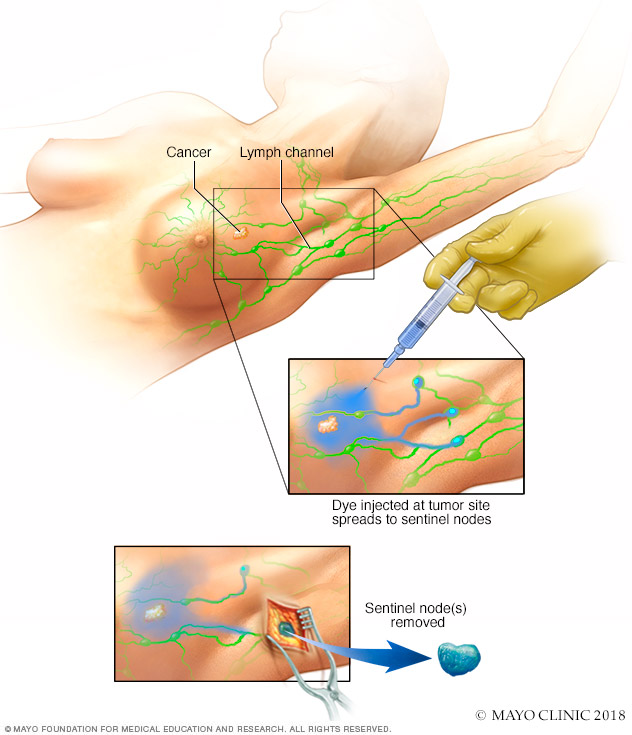
Sentinel node biopsy
Sentinel node biopsy identifies the first few lymph nodes into which a tumor drains. The surgeon uses a harmless dye and a weak radioactive solution to locate the sentinel nodes. The nodes are removed and tested for signs of cancer.
What happens during and after mastectomy depends on:
- The type of mastectomy.
- Whether one or both breasts are removed.
- Whether lymph nodes are removed.
- Whether breast reconstruction or flat closure is done.
If you're having a mastectomy to treat cancer, the surgeon also may remove nearby lymph nodes. When breast cancer spreads, it often goes to the lymph nodes first.
Operations to remove lymph nodes include:
- Sentinel lymph node surgery. In a sentinel lymph node surgery, the surgeon removes the first few lymph nodes into which a cancer drains, called the sentinel nodes. These nodes are found using a radioactive tracer and sometimes a dye injected before surgery.
- Axillary node dissection. During an axillary node dissection, the surgeon removes the main group of lymph nodes from under the arm.
Lymph nodes removed during mastectomy are tested for cancer. Whether more lymph node treatment is needed depends on the results, the type of breast surgery and whether radiation therapy is planned.
Before the procedure
Before surgery, you can expect to:
- Receive instructions about when and where to arrive.
- Change into a hospital gown.
- Meet members of the surgical and anesthesia teams.
- Have an IV placed for medicines and fluids.
- Receive general anesthesia so that you're in a sleep-like state during surgery.
A total mastectomy usually takes 2 to 4 hours. Surgery may take longer if breast reconstruction is started during the same operation.
The surgery is often done as an outpatient procedure. Most people go home on the same day. Some people stay overnight or longer depending on the procedures performed and how they recover after surgery.
If you're having sentinel lymph node surgery, a radioactive tracer and sometimes a dye are injected near the cancer before surgery. The tracer and dye travel to the sentinel nodes. This allows the surgeon to find and remove the nodes during surgery.
During the procedure
The surgeon makes an incision in the breast and removes tissue according to the type of mastectomy planned.
- During a total mastectomy, the surgeon removes the whole breast, including the breast tissue, nipple, areola and skin.
- During a lumpectomy, also called a partial mastectomy, the surgeon removes the cancer and part of the surrounding breast tissue rather than the whole breast.
- During a modified radical mastectomy, the surgeon removes the whole breast and lymph nodes from under the arm.
- During a skin-sparing mastectomy, the surgeon removes the breast tissue, nipple and areola but preserves most of the breast skin.
- During a nipple-sparing mastectomy, the surgeon removes the breast tissue but preserves most of the breast skin, nipple and areola.
The breast tissue and any lymph nodes that are removed are sent to a lab for testing.
If you're having breast reconstruction at the same time as mastectomy, the plastic surgeon begins reconstruction after the breast tissue is removed. Reconstruction may use:
- A tissue expander that is later replaced with a permanent implant.
- A breast implant.
- Tissue from another part of your body.
- Body tissue and an implant used together.
If a tissue expander is used, the plastic surgeon places the temporary device under the skin or chest muscle. It is gradually filled with saline or air during follow-up visits. After the tissue has stretched and healed, the expander usually is removed and replaced with a saline or silicone implant.
If you're having mastectomy without reconstruction, the breast surgeon will create a smooth, flat chest and remove extra skin. This is called aesthetic flat closure.
As the surgery is completed:
- The incision is closed with stitches placed under the skin. These stitches dissolve over time.
- One or two small plastic drainage tubes are placed where the breast was removed. The tubes remove fluid that collects after surgery. They are sewn into place and attached to small drainage bulbs.
After the procedure
After surgery, you can expect to:
- Be taken to a recovery area where the healthcare team monitors you as you recover from surgery and anesthesia.
- Have a bandage over the surgical area.
- Feel some pain, numbness, tightness or a pinching feeling in your chest or underarm area.
- Receive instructions and medicines to help manage pain.
- Receive instructions about caring for the incision and drains, watching for infection and following activity restrictions.
- Talk with your healthcare team about when to wear a postsurgical bra or use a breast prosthesis.
- Learn when your follow-up appointment will be. A follow-up visit with the surgical team usually takes place 1 to 3 weeks after surgery.
Drains
Surgical drains may remain in place after you go home. A member of your healthcare team shows you how to care for them. Drains usually remain in place for 1 to 2 weeks, although timing depends on your procedure and healing.
Pain and sensation changes
Pain, numbness, tightness and changes in sensation may continue as the surgical area heals. Pain that lasts after healing is called postmastectomy pain syndrome.
Tell your healthcare team if pain is not improving, is getting worse or prevents you from doing the recommended exercises.
Incision care
Before you go home, your healthcare team will explain how to care for the incision and what signs of infection to watch for. Contact the team if the skin around the incision changes color, becomes more swollen, drains fluid, or feels increasingly painful. At first, the scar may look raised or firm, and its color may differ from the surrounding skin. Over time, the scar typically becomes flatter, softer and less noticeable as it heals.
Arm movement and activity
Shoulder stiffness and reduced arm movement can occur after breast surgery. Exercise and rehabilitation can improve shoulder movement and arm function.
Your surgical team will tell you:
- When to begin arm and shoulder exercises.
- How high you can lift your arm.
- How much weight you can lift.
- When you can drive.
- When you can return to work.
- When you can return to more intense activity.
Timing depends on the type of mastectomy, lymph node surgery, drains and reconstruction.
Unless your healthcare team gives you different instructions, gentle arm and shoulder exercises may begin about one week after surgery. If a drain is still in place, you may need to limit movement until it is removed. Follow the plastic surgeon's instructions if you had breast reconstruction.
Recovery
Recovery may take several weeks to months. Plan for extra rest during the first few weeks and gradually increase your activity as you heal.
During recovery, you may need help with:
- Drain care.
- Dressing and bathing.
- Household tasks.
- Transportation.
- Child care or other caregiving responsibilities.
Bras, breast forms and clothing
Wear clothing that feels comfortable and does not rub or press on the surgical area. Ask your healthcare team when it is safe to wear a bra after surgery and what type is recommended. If you use a breast prosthesis, you may wear it in a well-fitting bra or pocketed mastectomy bra. Pocketed swimwear and breast forms designed for swimming also are available.
Results
After surgery, the breast tissue and any lymph nodes that were removed are sent to a lab for testing. The results help show:
- The type and size of the cancer.
- Whether cancer reaches the edges of the removed tissue, called the surgical margins.
- Whether cancer was found in the lymph nodes.
The results usually are available within one or two weeks after surgery. Your healthcare team will explain what the results mean and what the next steps will be in your treatment.
If you need more treatment, you may be referred to:
- A radiation oncologist, a doctor who specializes in radiation treatment, to discuss radiation therapy. Radiation may be recommended after mastectomy for some people at higher risk of cancer returning. This includes people whose lymph nodes contain cancer or who have a large cancer.
- A medical oncologist, a doctor who treats cancer with medicines, to discuss medicines used after surgery. These may include hormone therapy, chemotherapy, targeted therapy or immunotherapy, depending on the features of the cancer.
- A plastic surgeon if you're considering breast reconstruction.
- A counselor or support group to help you cope with breast cancer and changes after surgery.
Mastectomy lowers the risk that breast cancer will return in the breast or chest area, but it does not reduce the risk to zero. Cancer can return in the skin, tissue under the skin, nipple and areola, or chest wall.
Breast tissue that is removed does not grow back. However, a small amount of breast tissue remains after mastectomy, especially after procedures that preserve the skin or nipple.
Clinical trials
Explore Mayo Clinic studies of tests and procedures to help prevent, detect, treat or manage conditions.