Overview
CT scan
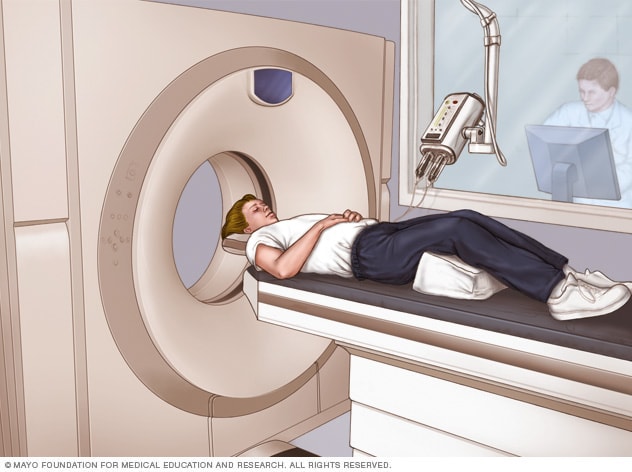
CT scan
A CT scan can be used to visualize nearly all parts of the body. It is used to diagnose disease or injury as well as to plan medical, surgical or radiation treatment.
Lung cancer screening is a way to look for lung cancer in people at high risk who have no symptoms. People at high risk of lung cancer are older adults who have a history of longtime smoking.
During lung cancer screening, healthcare professionals use a low-dose computerized tomography (LDCT) scan of the lungs to look for lung cancer. Lung cancer found at an early stage is more likely to be cured with treatment.
Talk with your healthcare professional about the pros and cons of lung cancer screening using low-dose CT. Together, you can decide whether screening is right for you.
Products & Services
Why it's done
The goal of lung cancer screening is to find lung cancer at the earliest stage, when it's more likely to be cured. By the time lung cancer symptoms happen, the cancer may be too far along to be cured. Studies show lung cancer screening lowers the risk of dying of lung cancer.
Who it's for
Lung cancer screening is mainly for people with the greatest risk of lung cancer, including:
- Older adults who smoke or used to smoke. These are people ages 50 to 80 who smoke now or who used to smoke.
-
People who have smoked a lot for years. You may think about lung cancer screening if you have a 20 pack-year or greater smoking history. Pack years are the number of packs of cigarettes you smoked a day multiplied by the number of years that you smoked.
For instance, a person with a 20 pack-year smoking history may have smoked a pack a day for 20 years, two packs a day for 10 years or half a pack a day for 40 years. Even if your smoking habits changed over the years, your healthcare professional can use what you remember about your smoking history to see whether lung cancer screening may be right for you.
- People who smoked a lot but quit. If you were a heavy smoker for a long time and you quit smoking in the last 15 years, you may think about lung cancer screening. You might stop screening after you haven't smoked for more than 15 years.
- People with a history of lung cancer. If you were treated for lung cancer more than five years ago, you might think about lung cancer screening.
- People with risk factors for lung cancer. Risk factors for lung cancer may include having chronic obstructive pulmonary disease (COPD), having a family history of lung cancer and having been around asbestos at work.
If you have serious health conditions, lung cancer screening may be less likely to be useful for you. And you may be more likely to have complications from follow-up tests. For this reason, lung cancer screening is for people whose health is mainly good.
Screening may not be for people whose lungs don't work well or who have other serious conditions that would make surgery hard. This may include people who use oxygen to help them breathe. It may include people who have lost weight for no known reason in the past year. It also may include people who have coughed up blood recently or have had a chest CT scan in the last year.
How long to keep screening
Not all medical groups agree on a standard age to stop lung cancer screening. Most people should have yearly lung cancer screening until the screening no longer is likely to be useful. This may be because you get other serious conditions that make you too weak for lung cancer treatment.
More Information
Risks
Risks of lung cancer screening include:
Getting a low level of radiation
A low-dose CT scan gives you much less radiation than does a standard CT scan. A low-dose CT scan gives you about half the radiation you get naturally from the environment in a year.
Needing follow-up tests
If your scan shows a spot in one of your lungs that could be cancer, you may need to have more scans or tests. More scans mean more radiation. Or you may have tests such as a biopsy that carry serious risks. You may have these added tests and find out you don't have lung cancer. This is called a false-positive result.
For some people, finding out that there is no cancer is a relief. For others, having tests and procedures for no reason upsets them.
Finding cancer that's too far along to cure
Treatment may not help advanced lung cancers, such as those that have spread. So finding these cancers on a lung cancer screening test might not help you.
Finding cancer that might never grow
Some lung cancers grow slowly and may never cause symptoms or harm. It's hard to know which cancers are growing slowly and which need to be treated quickly. If the tests find lung cancer, treatment is likely to be next. Treating a cancer that would never have caused harm may not help you live longer.
Missing cancers
Lung cancer screening tests may miss some cancers. Your results may show that you don't have lung cancer when you do. This is called a false-negative result.
Finding other health conditions
People who smoke for a long time have a higher risk of other health issues, including lung and heart conditions, that a lung CT scan may find. If the scan finds another condition, you may need more tests and maybe treatment.
How you prepare
To get ready for lung cancer screening with a low-dose CT scan, you may need to:
Tell your healthcare professional if you have a respiratory tract infection
If you have symptoms of an infection that affects your nose, throat, airways or lungs, your healthcare professional may suggest that you wait to be screened. If you just got over an infection, you may need to wait until one month after your symptoms go away. Respiratory infections can cause findings on CT scans that might need more scans or tests. You won't need these added tests if you wait for the infection to clear.
Remove any metal you're wearing
Metal can get in the way of imaging. So you may need to take off any metal you have on, such as jewelry, glasses, hearing aids and dentures. Don't wear clothes that have metal buttons or snaps. Don't wear an underwire bra. If your clothing has too much metal, you may need to change into a gown.
What you can expect
During lung cancer screening
Lung cancer screening involves having a low-dose CT scan of the lungs. During the scan, you lie on your back on a long table. You may get a pillow to make you more comfortable.
The technologist who runs your scan will move to another room. From there, the technologist can still see you and talk with you.
You need to lie still as the table slides through the center of a large machine that makes the images of your lungs. First, the table passes through the machine to find the starting point for the scan.
When the machine is ready to start the scan, the technician may ask you to hold your breath for a few seconds. This helps get a clear picture of your lungs. The table moves quickly through the machine as the images are made. You may hear knocking or clicking noises.
The scan takes less than a minute. But your appointment may last about a half hour.
After lung cancer screening
When your low-dose CT scan is done, you can go about your day as usual.
A doctor who specializes in diagnosing lung cancer with imaging tests, called a chest radiologist, reviews the pictures from the scan.
Results
Lung cancer screening results may show:
No concerns
If there are no concerns with your scans, your healthcare professional may suggest you have another scan in a year. You may want to get yearly scans until you and your healthcare professional think they may no longer be useful. This might happen if you get a serious health condition.
Lung nodules
On a low-dose CT scan, lung cancer may appear as a small spot in the lungs. This small spot is called a nodule. But many other lung conditions look the same. This includes scars from lung infections and growths that aren't cancer. In studies, as many as half the people who have lung cancer screening have one or more nodules show up on a low-dose CT scan.
Most small nodules don't need action right away. Your healthcare professional may check them at your next yearly lung cancer screening. Or your healthcare professional may suggest that you have another low-dose CT scan in a few months to see if the lung nodule grows. Growing nodules are more likely to be cancer.
Large nodules also are more likely to be cancer. If you have a large nodule, your healthcare professional may send you to a lung specialist, called a pulmonologist, for more tests. These tests may include a procedure to remove a piece of the nodule for lab testing, called a biopsy. You also may have more imaging tests, such as a positron emission tomography (PET) scan.
Other health conditions
Your lung cancer screening test may show other lung and heart conditions that are common in people who have smoked for a long time. These may include emphysema and hardening of the arteries in the heart. Emphysema is a long-term lung condition that causes shortness of breath. If your lung cancer screening test finds another condition, talk with your healthcare professional about whether you need more tests.
Clinical trials
Explore Mayo Clinic studies of tests and procedures to help prevent, detect, treat or manage conditions.
Sept. 16, 2026