Tachycardia Care at Mayo Clinic
Tachycardia care at Mayo Clinic
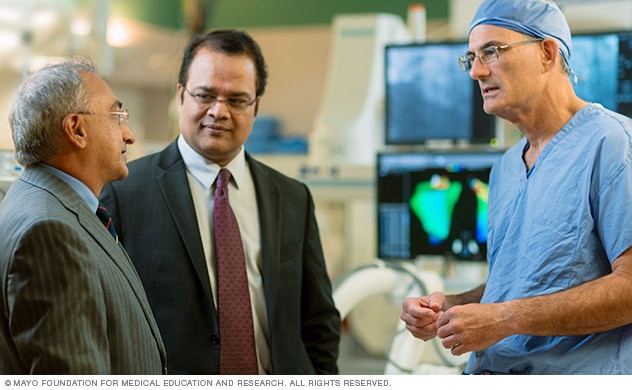
Tachycardia teamwork at Mayo Clinic
At Mayo Clinic, an interdisciplinary team of tachycardia experts works together to provide compassionate, whole-person care.
- Your Mayo Clinic care team. At Mayo Clinic, a team of doctors trained in heart conditions (cardiologists), heart surgery (cardiovascular surgeons) and heart rhythm disorders (electrophysiologists) works together to provide care for people with tachycardia. Mayo Clinic's campuses in Arizona, Florida and Minnesota each offer a Heart Rhythm Clinic. The clinic is staffed by health professionals trained in evaluating and treating heart rhythm disorders.
- Advanced diagnosis and treatment. Mayo Clinic healthcare professionals use advanced mapping systems to treat tachycardia and other heart rhythm disorders. Examples include multielectrode mapping and 3D heart mapping.
Expertise and rankings

Tachycardia treatment at Mayo Clinic
Mayo Clinic campuses are nationally recognized for expertise in cardiology and cardiovascular surgery.
Mayo Clinic's cardiovascular medicine and cardiovascular surgery departments are recognized by outside organizations for providing outstanding patient care. These endorsements reinforce Mayo Clinic's commitment to providing expert, whole-person care to everyone who needs healing.
Each year, Mayo Clinic healthcare professionals treat more than 19,500 people with tachycardia.
Nationally recognized expertise
Mayo Clinic also is recognized for high-quality cardiology and heart surgery subspecialty care, research, and education by a variety of national organizations:
- Intersocietal Accreditation Commission Echocardiography. Mayo Clinic has been accredited by Intersocietal Accreditation Commission Echocardiography in the areas of adult transthoracic, adult transesophageal and adult stress echocardiography. Mayo Clinic's campus in Minnesota also has been accredited in pediatric transthoracic, pediatric transesophageal and fetal echocardiography.
- Commission on Accreditation of Allied Health Education Programs. Mayo Clinic's campus in Minnesota has been accredited by the Commission on Accreditation of Allied Health Education Programs in cardiac catheterization.
Mayo Clinic in Rochester, Minnesota, Mayo Clinic in Phoenix/Scottsdale, Arizona, and Mayo Clinic in Jacksonville, Florida, are ranked among the Best Hospitals for heart and heart surgery by U.S. News & World Report. Mayo Clinic Children's in Rochester is ranked the No. 1 hospital in Minnesota and the five-state region of Iowa, Minnesota, North Dakota, South Dakota and Wisconsin, according to U.S. News & World Report's 2025-2026 "Best Children's Hospitals" rankings.
Learn more about Mayo Clinic's cardiovascular medicine and cardiovascular surgery departments' expertise and rankings.
Locations, travel and lodging
Mayo Clinic has major campuses in Phoenix and Scottsdale, Arizona; Jacksonville, Florida; and Rochester, Minnesota. The Mayo Clinic Health System has dozens of locations in several states.
For more information on visiting Mayo Clinic, choose your location below:


Costs and insurance
Mayo Clinic works with hundreds of insurance companies and is an in-network provider for millions of people.
In most cases, Mayo Clinic doesn't require a physician referral. Some insurers require referrals or may have additional requirements for certain medical care. All appointments are prioritized on the basis of medical need.
Learn more about appointments at Mayo Clinic.
Please contact your insurance company to verify medical coverage and to obtain any needed authorization prior to your visit. Often, your insurer's customer service number is printed on the back of your insurance card.
More information about billing and insurance:
Top ranked in the U.S.
Mayo Clinic in Rochester, Minnesota, has been recognized as one of the top Cardiology & Heart Surgery hospitals in the nation by U.S. News & World Report.
CON-20214607
