Progressive supranuclear palsy Symptoms and causes
Overview
Progressive supranuclear palsy (PSP) is a rare brain disease that affects movement, balance, vision, and swallowing. It happens when certain brain cells that control body movement, thinking, and coordination become damaged. PSP can make it hard to walk, keep your balance, move your eyes and swallow. The condition happens because certain brain cells that control body movement, thinking and coordination get damaged.
Progressive supranuclear palsy is one of the most common types of atypical parkinsonism. Atypical parkinsonism is a group of conditions that share some symptoms with Parkinson's disease. PSP also is called Steele-Richardson-Olszewski syndrome.
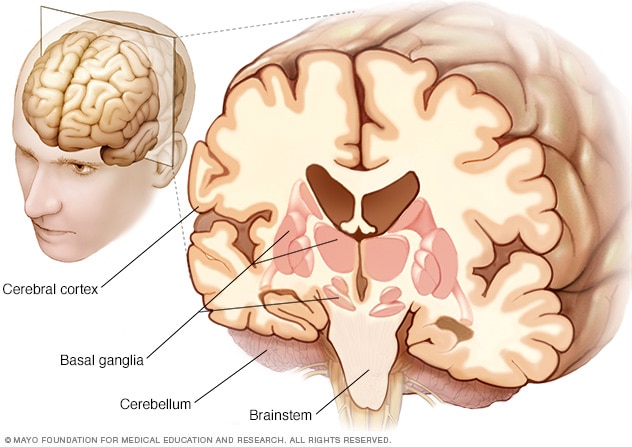
Cause of supranuclear palsy
Damage to cells in the brainstem, cerebral cortex, cerebellum and basal ganglia — a cluster of cells deep within your brain — is what causes the coordination and movement issues of progressive supranuclear palsy.
Progressive supranuclear palsy gets worse over time and can lead to dangerous complications, such as pneumonia and trouble swallowing. There's no cure for PSP, so treatment focuses on managing the symptoms.
Symptoms
Symptoms of progressive supranuclear palsy (PSP) include:
- Changes in movement and balance. People with PSP may have trouble walking or balancing. Your walk may be stiff, and your steps may be uneven or wide. Sudden movements, such as jumping out of a chair, also can happen. Falling — especially backward — is another key symptom. Your body's natural reflexes that help you stay upright might not work as well. This can make it hard to catch yourself if you lose balance. People with the condition may fall backward stiffly, like a tree.
- Eye and vision issues. Vision changes are common for many people with PSP. The condition can make it difficult to move your eyes up or down or aim your eyes properly. People with PSP may not be able to look downward. Or they may experience blurring and double vision. Not being able to focus the eyes can make it more difficult to read or walk down a flight of stairs. Some people may have a hard time making eye contact during conversation. Some people may be sensitive to bright light and need to wear sunglasses.
Other symptoms of progressive supranuclear palsy can be different for each person. Some symptoms are similar to Parkinson's disease and dementia. Symptoms can change and get worse over time and may include:
- Stiffness, especially of the neck, and awkward movements.
- Falling, especially falling backward.
- Slow or slurred speech or strained voice.
- Trouble swallowing, which may cause gagging or choking.
- Being sensitive to bright light.
- Trouble with sleep.
- Loss of interest in pleasurable activities.
- Impulsive behavior or laughing or crying for no reason.
- Trouble with reasoning, problem-solving and decision-making.
- Depression, anxiety or obsessive-compulsive disorder.
- A surprised or frightened facial expression, resulting from rigid facial muscles.
- Dizziness.
When to see a doctor
Make an appointment with your healthcare professional if you have any symptoms of progressive supranuclear palsy.
Causes
The exact cause of progressive supranuclear palsy (PSP) isn't known. Symptoms of PSP are caused by damage to cells in certain areas of the brain that help you control body movements and thinking.
Researchers have found that the damaged brain cells of people with PSP have too much of a protein called tau. Clumps of tau also are found in other brain diseases, such as Alzheimer's disease.
Rarely, progressive supranuclear palsy occurs within a family. But a genetic link isn't clear. Research suggests that changes in a gene called MAPT may cause PSP, but more research is needed. Most people with the condition don't inherit it from a family member.
Risk factors
Age is the only proven risk factor for progressive supranuclear palsy (PSP). The condition usually shows up when someone is in their 60s or 70s. It's uncommon in people under the age of 50.
Complications
Complications of progressive supranuclear palsy (PSP) are usually caused by slow and difficult muscle movements. Complications may include:
- Falling, which could lead to head injuries, fractures and other injuries.
- Trouble focusing your eyes, which also can lead to injuries.
- Trouble sleeping, which can lead to feeling tired and sleeping a lot during the day.
- Not being able to look at bright lights.
- Trouble swallowing, which can lead to choking or inhaling food or liquid into the airway, called aspiration.
- Pneumonia, which can be caused by aspiration. Pneumonia is the most common cause of death in people with PSP.
- Impulsive behaviors. For example, standing up without waiting for help, which can lead to falls.
Your healthcare professional may recommend a swallowing evaluation and possibly a feeding tube to help you avoid choking hazards. To avoid falling injuries, you might use walking aids such as a weighted walker.



CON-20251943
Mayo Clinic does not endorse companies or products. Advertising revenue supports our not-for-profit mission.
Advertising & Sponsorship
Mayo Clinic Press
Check out these best-sellers and special offers on books and newsletters from Mayo Clinic Press.
