Overview
What is pancreatic cancer? A Mayo Clinic expert explains
Learn more about pancreatic cancer from Mayo Clinic surgical oncologist Chee-Chee Stucky, M.D.
Hi. I'm Dr. Chee-Chee Stucky, a surgical oncologist at Mayo Clinic. In this video, we'll cover the basics of pancreatic cancer: What is it? Who gets it? What are the symptoms, diagnosis and treatment? Whether you're looking for answers for yourself or someone you love, we're here to give you the best information available. Understanding pancreatic cancer starts with understanding the pancreas. This small, fish-shaped organ sits behind the stomach, producing enzymes that aid digestion and hormones that regulate blood sugar. Pancreatic cancer typically starts in the ducts of the pancreas. Small changes in the cellular DNA result in uncontrolled multiplication and accumulation of cells in clusters called tumors. If untreated, these cancer cells can spread outside of the pancreas to other parts of the body.
Who gets it?
While anyone can get pancreatic cancer, there are certain risk factors to be aware of. Most pancreatic cancer is diagnosed after age 65. Smoking, diabetes, chronic pancreatitis or inflammation of the pancreas, family history of pancreatic cancer, and certain genetic syndromes are all known risk factors. Carrying extra weight that is unhealthy for your body may also be a contributing factor. New research has found that the specific combination of smoking, diabetes and poor diet increases the risk of pancreatic cancer the most beyond any one factor alone.
What are the symptoms?
Unfortunately, we don't usually see the signs of pancreatic cancer until it's in more advanced stages. When present, symptoms may include: Abdominal pain that radiates to the back. A loss of appetite or unintentional weight loss. Jaundice, which is the yellowing of your skin or eyes. Light colored stools. Dark colored urine. Particularly itchy skin. Diabetes that's becoming unusually difficult to control. Blood clots or fatigue.
How is it diagnosed?
If your doctors think you may have pancreatic cancer, they may recommend one or more diagnostic tests. For instance, imaging tests like an ultrasound, CT scan, MRI, or PET scan, can help your doctor see a clearer picture of your internal organs. An endoscopic ultrasound, or EUS, is when the doctor passes a tiny camera down the esophagus and into the stomach to get a close-up view of the pancreas. During the EUS, the doctor might collect a biopsy of the tissue for further testing. Sometimes pancreatic cancer can shed specific proteins called tumor markers in your blood. So your doctors may request blood tests to identify elevation of these markers, one of which is called CA 19-9. If a diagnosis is confirmed, the next step is to determine the extent or stage of the cancer. The stages are numbered one through four and may need to be determined by additional testing. Feel free to ask lots of questions during this process. Or get a second opinion to feel the most confident and empowered moving into treatment.
How is it treated?
When recommending treatment for pancreatic cancer, your doctor is considering many factors, including your overall health and personal preferences. They may recommend one or a combination of the following treatments: Chemotherapy uses drugs that release chemicals that enter the body and kill cancerous cells that may be throughout. Radiation, similarly kills the cancer cells, but with high-energy beams directed at the tumor. Surgery is used to physically remove the cancer and the immediate surrounding area. Ask your doctor if you qualify for clinical trials that test new treatments. And lastly, there is palliative care. This care is provided by a team of doctors, nurses, social workers, and other trained professionals who specialize in providing much needed relief from the pain and unpleasant symptoms of a serious illness.
What now?
Getting diagnosed with a life-threatening illness can be devastating to both the patient and their loved ones. But we have some of the following suggestions that may help patients cope: Learn about your condition. Knowledge is power and information can make you feel more confident in your treatment decisions. Find support. This can mean a support system of family and friends, a cancer support group of people going through the same experience, or qualified counselor like your therapist or religious leader. Lean on those around you when you're feeling helpless, overwhelmed, or uncertain. You may want to consider hospice care, which provides comfort and support to terminally ill patients and their loved ones. If you'd like to learn even more about pancreatic cancer, watch our other related videos or visit mayoclinic.org. We wish you well.
Pancreatic cancer is a type of cancer that starts as a growth of cells in the pancreas. The pancreas lies behind the lower part of the stomach. It makes enzymes that help digest food. It also makes hormones that help manage blood sugar.
The most common type of pancreatic cancer is pancreatic ductal adenocarcinoma. This type of cancer starts in the cells that line the ducts that carry digestive enzymes out of the pancreas.
Another, much less common type of pancreatic cancer starts in the hormone-making cells of the pancreas. These cancers are called pancreatic neuroendocrine tumors. They make up only a small share of cancers that start in the pancreas.
Pancreatic cancer rarely is found in its early stages when the chance of curing it is greatest. That's because pancreatic cancer often doesn't cause symptoms until after it has spread to other organs.
Treatment for pancreatic cancer is based on the cancer's stage and whether it has spread outside the pancreas. Treatment may include surgery, chemotherapy, radiation therapy, immunotherapy, targeted therapy or a mix of those options.
Pancreatitis is inflammation of the pancreas. It is a different condition from pancreatic cancer. But long-lasting pancreatitis, called chronic pancreatitis, can raise the risk of pancreatic cancer.
Pancreatic cancer
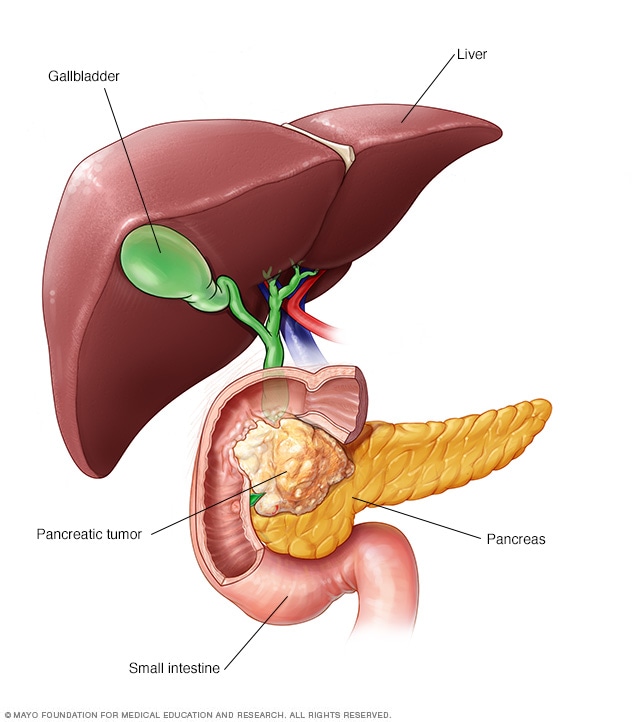
Pancreatic cancer
Pancreatic cancer is cancer that forms in the cells of the pancreas.
Products & Services
Symptoms
Pancreatic cancer often doesn't cause symptoms until the disease is advanced. When signs and symptoms occur, they may include:
- Belly pain that spreads to the sides or back.
- Weight loss.
- Yellowing of the skin and the whites of the eyes, called jaundice.
- Tiredness or weakness.
- Loss of appetite.
- Dark urine.
- Nausea.
- Light-colored or floating stools.
- New diagnosis of diabetes or diabetes that's getting harder to manage.
- Pain and swelling in an arm or a leg, which might be caused by a blood clot.
- Itching.
When pancreatic cancer spreads
Pancreatic cancer can spread to other parts of the body. It most often spreads to the liver, the lungs and the tissue that lines the inside of the belly. Less often, it spreads to the bones.
When pancreatic cancer has spread, fluid may build up in the belly. This is called ascites.
When to see a doctor
Make an appointment with a healthcare professional if you have symptoms that worry you.
Causes
It's not clear what causes pancreatic cancer. There are some things that might raise the risk of this type of cancer. They include smoking and having a family history of pancreatic cancer.
Understanding the pancreas
The pancreas is about 6 inches, which is about 15 centimeters (cm), long and looks something like a pear lying on its side. It makes hormones, including insulin. These hormones help the body process the sugar in the foods you eat. The pancreas also makes digestive juices to help the body digest food.
The pancreas in the digestive system
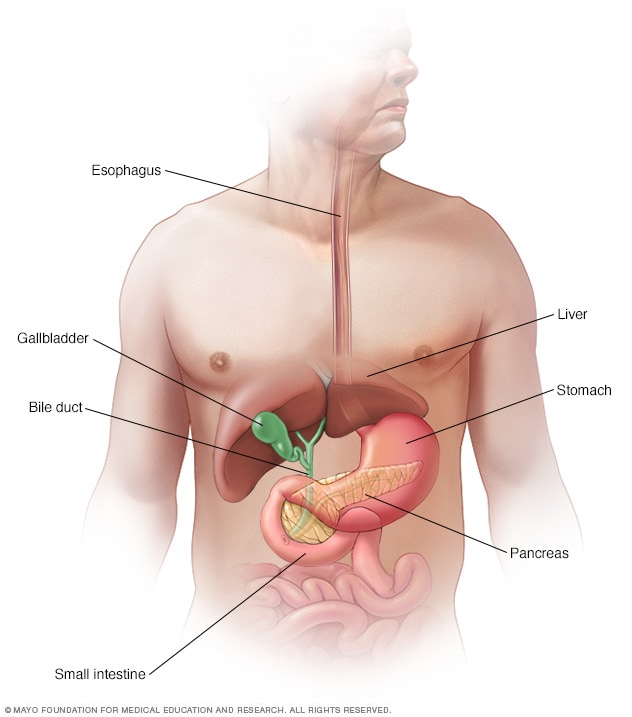
The pancreas in the digestive system
The pancreas is a long, flat gland that lies horizontally behind your stomach. It has a role in digestion and in regulating the level of sugar in your blood.
How pancreatic cancer forms
Pancreatic cancer happens when cells in the pancreas get changes in their DNA. A cell's DNA holds the instructions that tell a cell what to do. In healthy cells, the instructions tell the cells to grow and multiply at a set rate. The cells die at a set time. In cancer cells, the DNA changes give different instructions. The changes tell the cancer cells to make many more cells quickly. Cancer cells can keep living when healthy cells would die. As a result, too many cells build up.
The cancer cells might form a clump of cells called a tumor. The tumor can grow to invade and destroy healthy body tissue. In time, cancer cells can break away and spread to other parts of the body.
Most pancreatic cancer begins in the cells that line the ducts of the pancreas. This type of cancer is called pancreatic ductal adenocarcinoma or pancreatic exocrine cancer. Less often, cancer can form in the hormone-making cells of the pancreas, called neuroendocrine cells. These cancers are called pancreatic neuroendocrine tumors or pancreatic endocrine cancer.
Risk factors
The risk of pancreatic cancer may go up due to:
- Smoking.
- Type 2 diabetes.
- Swelling of the pancreas that lasts over time, called pancreatitis.
- Family history of DNA changes that can raise cancer risk. These include changes in the BRCA2 gene, Lynch syndrome and familial atypical multiple mole melanoma syndrome.
- Family history of pancreatic cancer.
- Obesity.
- Older age. Most people with pancreatic cancer are 65 or older.
- Drinking a lot of alcohol.
Complications
As pancreatic cancer gets worse, it can cause a number of health concerns called complications.
Weight loss
People with pancreatic cancer might lose weight as the cancer uses more of the body's energy. Nausea and vomiting caused by cancer treatment or cancer pressing on the stomach might make it hard to eat. Sometimes the body has trouble getting nutrients from food because the pancreas isn't making enough digestive juices.
Jaundice
Pancreatic cancer that blocks the liver's bile duct can cause jaundice. Symptoms of jaundice include yellowing of the skin and the whites of the eyes. Jaundice can cause dark-colored urine and pale-colored stools. Jaundice often happens without belly pain.
If the bile duct is blocked, a plastic or metal tube called a stent can be put inside it. The stent helps hold the bile duct open. This is done using a procedure called endoscopic retrograde cholangiopancreatography (ERCP).
During ERCP, a healthcare professional puts a long tube with a tiny camera, called an endoscope, down the throat. The tube goes through the stomach and into the upper part of the small intestine. Then, through a small tube that fits through the endoscope, contrast material is put into the pancreatic ducts and bile ducts. The contrast material helps the ducts show up on X-ray images. Those images are used to place a stent at the right spot in the duct to help hold it open.
Endoscopic retrograde cholangiopancreatography
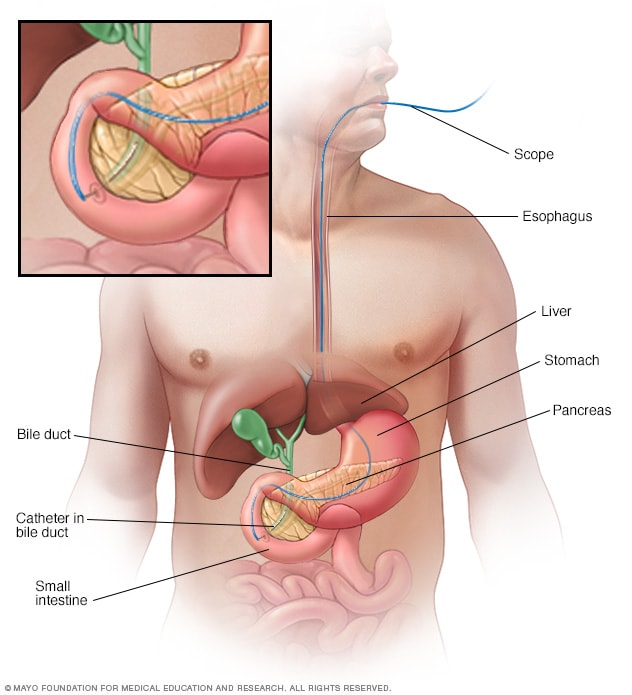
Endoscopic retrograde cholangiopancreatography
Endoscopic retrograde cholangiopancreatography (ERCP) uses contrast material to highlight the bile ducts on X-ray images. A thin, flexible tube with a camera on the end, called an endoscope, goes through the throat and into the small intestine. The contrast material enters the ducts through a small hollow tube, called a catheter, passed through the endoscope.
Pain
Growing cancer may press on nerves in the belly, causing pain that can become serious. Pain medicines can help. Treatments, such as radiation therapy and chemotherapy, might help slow cancer growth and ease pain.
When medicines don't help ease pain, a celiac plexus block may be useful. In this procedure, a needle is used to put alcohol into the nerves that control pain in the belly. The alcohol stops the nerves from sending pain signals to the brain.
Blocked bowel
Pancreatic cancer can grow into or press on the first part of the small intestine, called the duodenum. This can block the flow of digested food from the stomach into the intestines. In that situation, several treatments are available. They include a procedure in which the stomach is attached to the small intestine away from the blockage. This is called a bypass. Or a tube called a stent may be placed in the blocked intestine to hold it open. Sometimes a feeding tube may be placed in the stomach or small intestine.
Prevention
Screening tests
Routine screening for pancreatic cancer isn't recommended for adults without symptoms who aren't at high risk. Also, there are no accurate, validated blood tests for screening the general population for pancreatic cancer.
Screening may be an option for people at high risk of pancreatic cancer. These include some people with a strong family history of pancreatic cancer or an inherited DNA change that raises cancer risk.
Screening may include imaging tests such as MRI and endoscopic ultrasound. These tests often are repeated at regular intervals. The goal is to find pancreatic cancer or concerning changes when they are small and may be easier to treat.
Screening also has possible harms. For example, a test may find a change that leads to more testing or surgery but later turns out not to be cancer. Talk with your healthcare team about the possible benefits and risks of screening and whether it may be right for you.
Genetic testing for cancer risk
If you have a family history of pancreatic cancer, talk about it with a healthcare professional. The health professional can review your family history and help you understand whether genetic testing might be right for you.
Genetic testing can find DNA changes that can be passed down in families and raise the risk of cancer. If you're interested in genetic testing, you might be referred to a genetic counselor or another healthcare professional trained in genetics.
Ways to lower risk
You might lower your risk of pancreatic cancer if you:
- Stop smoking. If you smoke, talk with a member of your healthcare team about ways to help you stop. These might include support groups, medicines and nicotine replacement therapy.
- Stay at a healthy weight. If you are at a healthy weight, try to stay there. If you need to lose weight, aim for a slow, steady weight loss of 1 to 2 pounds (0.5 to 1 kilogram) a week. To help you lose weight, exercise most days of the week. Slowly increase how long you exercise over time. Choose a diet rich in vegetables, fruit and whole grains in smaller portions.
Sept. 17, 2026