Overview
Thyroid gland
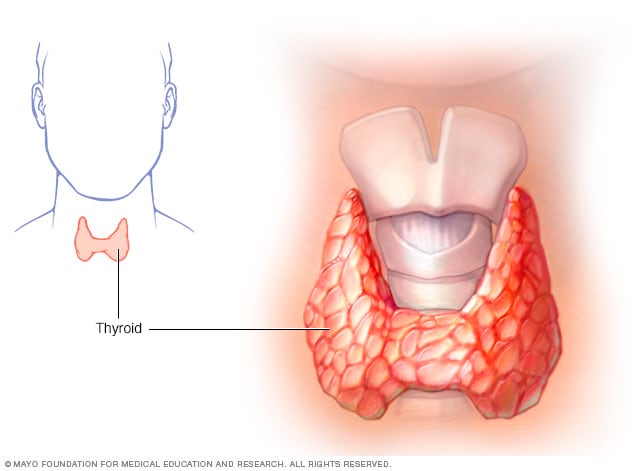
Thyroid gland
The thyroid gland is found at the base of the neck, just below the Adam's apple.
Graves' disease is an immune system condition that affects the thyroid gland. It causes the body to make too much thyroid hormone. That condition is called hyperthyroidism.
Thyroid hormones affect many organs in the body. So Graves' disease symptoms also can affect those organs. Anyone can get Graves' disease. But it's more common in women and in people older than 30.
Treatment for Graves' disease helps lower the amount of thyroid hormone that the body makes and eases symptoms.
Products & Services
Symptoms
Enlarged thyroid
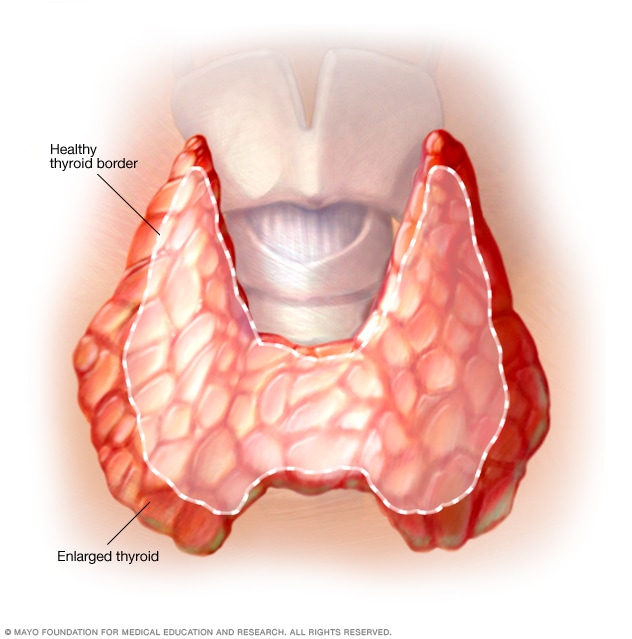
Enlarged thyroid
An enlarged thyroid can cause a bulge in the neck.
Common symptoms of Graves' disease include:
- Feeling nervous and irritable.
- Having a slight tremor of the hands or fingers.
- Being sensitive to heat with an increase in sweating or warm, moist skin.
- Losing weight, despite wanting to eat more.
- Having an enlarged thyroid gland, also called goiter.
- Having changes in menstrual cycles.
- Not being able to get or keep an erection, called erectile dysfunction, or having less desire for sex.
- Having bowel movements often.
- Having bulging eyes — a condition called thyroid eye disease or Graves' ophthalmopathy.
- Being tired.
- Having thick, discolored skin mostly on the shins or tops of the feet, called Graves' dermopathy.
- Having fast or irregular heartbeat, called palpitations.
- Not sleeping well.
Thyroid eye disease
Thyroid eye disease
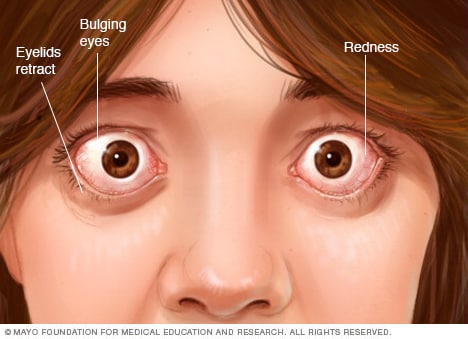
Thyroid eye disease
Thyroid eye disease symptoms include bulging eyes and redness. The eyelids may not cover the eyeball all the way. This eye condition also is called Graves' ophthalmopathy.
Thyroid eye disease also is called Graves' ophthalmopathy. About 25% of people with Graves' disease have eye symptoms. Thyroid eye disease affects muscles and other tissues around the eyes. Symptoms may include:
- Bulging eyes.
- A gritty feeling in the eyes.
- Pressure or pain in the eyes.
- Puffy eyelids or eyelids that don't cover the eyeball all the way. This is called retracted eyelids.
- Red or inflamed eyes.
- Light sensitivity.
- Blurred or double vision.
- Vision loss.
Graves' dermopathy
Graves' dermopathy
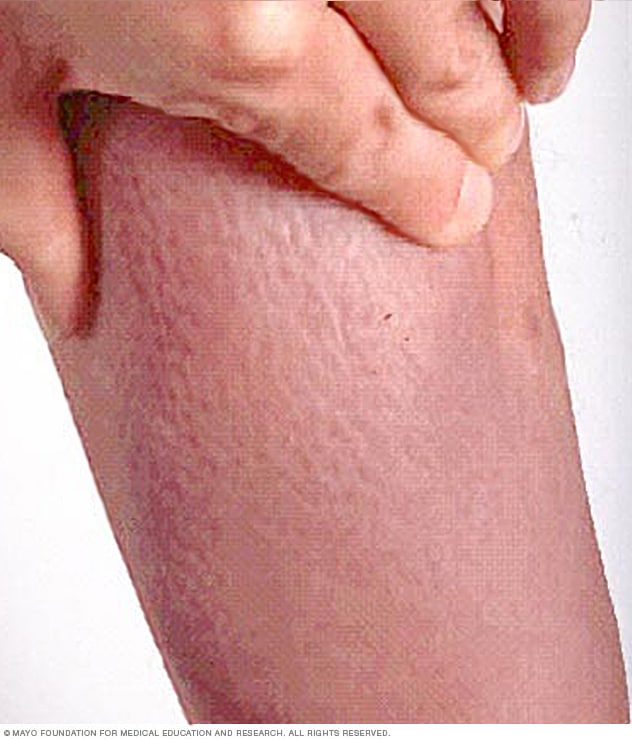
Graves' dermopathy
Rarely, people who have Graves' disease have skin that darkens and thickens. The skin has a texture like an orange peel. This is called Graves' dermopathy. It comes from a buildup of protein in the skin. It often appears on the shins and on the tops of the feet.
Rarely, people with Graves' disease have darkening and thickening of the skin. It most often appears on the shins or the tops of the feet. The skin has a texture like an orange peel.
This is called Graves' dermopathy. It comes from a buildup of protein in the skin. It's most often mild and painless.
When to see a doctor
Other medical conditions can cause symptoms like those of Graves' disease. See your healthcare professional if you have any symptoms of Graves' disease to get a prompt diagnosis.
Seek medical care right away if you have heart-related symptoms, such as a fast or irregular heartbeat, or if you have vision loss.
Causes
Graves' disease is caused by the body's disease-fighting immune system not working correctly. Experts don't know why this happens.
The immune system makes antibodies that target viruses, bacteria or other foreign substances. In Graves' disease, the immune system makes an antibody to one part of the cells in the hormone-making gland in the neck, called the thyroid gland.
A tiny gland at the base of the brain, called the pituitary gland, makes a hormone that controls the thyroid gland. The antibody linked with Graves' disease is called thyrotropin receptor antibody (TRAb). TRAb takes over the work of the pituitary hormone. That leads to more thyroid hormone in the body than the body needs. That condition is called hyperthyroidism.
Cause of thyroid eye disease
Thyroid eye disease, also called Graves' ophthalmopathy, comes from a buildup of certain carbohydrates in the muscles and tissues behind the eyes. The cause isn't known. It may involve the same antibody that can cause the thyroid gland to not work correctly.
Thyroid eye disease often appears at the same time as hyperthyroidism or several months later. But symptoms of thyroid eye disease can appear years before or after hyperthyroidism starts. It's also possible to have thyroid eye disease without hyperthyroidism.
Risk factors
Factors that can increase the risk of Graves' disease include:
- Family history. People who get Graves' disease often have a family history of thyroid conditions or an autoimmune condition.
- Sex. Women are much more likely to get Graves' disease than are men.
- Age. Graves' disease mostly happens between the ages of 30 and 60.
- Another autoimmune condition. People with other conditions of the immune system, such as type 1 diabetes or rheumatoid arthritis, have a higher risk.
- Smoking. Cigarette smoking, which can affect the immune system, raises the risk of Graves' disease. People who smoke and have Graves' disease are at higher risk of getting thyroid eye disease.
Complications
Complications of Graves' disease can include:
- Pregnancy health concerns. Graves' disease during pregnancy can cause miscarriage, early birth, fetal thyroid issues and poor fetal growth. It also can cause heart failure and preeclampsia in the pregnant person. Preeclampsia leads to high blood pressure and other serious symptoms.
- Heart conditions. Graves' disease that isn't treated can lead to irregular heart rhythms and changes in the heart and how it works. The heart might not be able to pump enough blood to the body. That condition is called heart failure.
-
Thyroid storm. This rare but deadly complication of Graves' disease also is called accelerated hyperthyroidism or thyrotoxic crisis. It's more likely to happen when severe hyperthyroidism is not treated or not treated well enough.
Thyroid storm happens when a sudden and drastic rise in thyroid hormones causes a number of effects in the body. They include fever, sweating, confusion, delirium, severe weakness, tremors, irregular heartbeat, severe low blood pressure and coma. Thyroid storm needs medical attention right away.
- Brittle bones. Hyperthyroidism that isn't treated can lead to weak, brittle bones — a condition called osteoporosis. The strength of the bones depends, in part, on the amount of calcium and other minerals they hold. Too much thyroid hormone makes it hard for the body to get calcium into the bones.