Psoriasis Symptoms and causes
Overview
Psoriasis is a skin disease that causes a rash with itchy, scaly patches, most commonly on the knees, elbows, trunk and scalp.
Psoriasis is a common, long-term (chronic) disease with no cure. It can be painful, interfere with sleep and make it hard to concentrate. The condition tends to go through cycles, flaring for a few weeks or months, then subsiding for a while. Common triggers in people with a genetic predisposition to psoriasis include infections, cuts or burns, and certain medications.
Treatments are available to help you manage symptoms. And you can try lifestyle habits and coping strategies to help you live better with psoriasis.
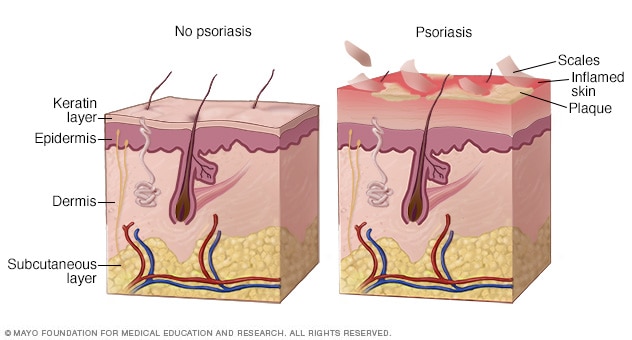
How psoriasis develops
In psoriasis, the life cycle of your skin cells greatly accelerates, leading to a buildup of dead cells on the surface of the epidermis.
Symptoms
Common signs and symptoms of psoriasis include:
- A patchy rash that varies widely in how it looks from person to person, ranging from spots of dandruff-like scaling to major eruptions over much of the body
- Rashes that vary in color, tending to be shades of purple with gray scale on brown or Black skin and pink or red with silver scale on white skin
- Small scaling spots (commonly seen in children)
- Dry, cracked skin that may bleed
- Itching, burning or soreness
- Cyclic rashes that flare for a few weeks or months and then subside
There are several types of psoriasis, each of which varies in its signs and symptoms:
- Plaque psoriasis. The most common type of psoriasis, plaque psoriasis causes dry, itchy, raised skin patches (plaques) covered with scales. There may be few or many. They usually appear on the elbows, knees, lower back and scalp. The patches vary in color, depending on skin color. The affected skin might heal with temporary changes in color (post inflammatory hyperpigmentation), particularly on brown or Black skin.
- Nail psoriasis. Psoriasis can affect fingernails and toenails, causing pitting, abnormal nail growth and discoloration. Psoriatic nails might loosen and separate from the nail bed (onycholysis). Severe disease may cause the nail to crumble.
- Guttate psoriasis. Guttate psoriasis primarily affects young adults and children. It's usually triggered by a bacterial infection such as strep throat. It's marked by small, drop-shaped, scaling spots on the trunk, arms or legs.
- Inverse psoriasis. Inverse psoriasis mainly affects the skin folds of the groin, buttocks and breasts. It causes smooth patches of inflamed skin that worsen with friction and sweating. Fungal infections may trigger this type of psoriasis.
- Pustular psoriasis. Pustular psoriasis, a rare type, causes clearly defined pus-filled blisters. It can occur in widespread patches or on small areas of the palms or soles.
- Erythrodermic psoriasis. The least common type of psoriasis, erythrodermic psoriasis can cover the entire body with a peeling rash that can itch or burn intensely. It can be short-lived (acute) or long-term (chronic).
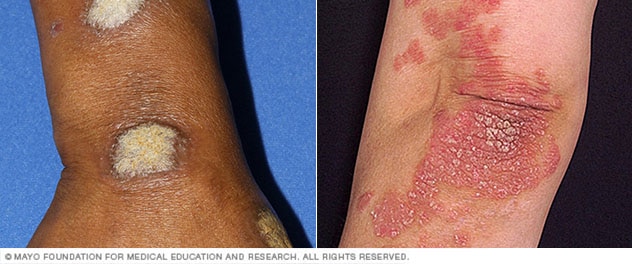
Plaque psoriasis
Plaque psoriasis is the most common type of psoriasis. It causes dry, raised skin patches (plaques) covered with scales.
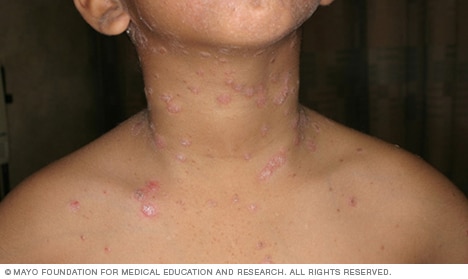
Guttate psoriasis
Guttate psoriasis, more common in children and young adults, appears as small, water-drop-shaped spots on the trunk, arms or legs. These spots are typically covered by a fine scale.
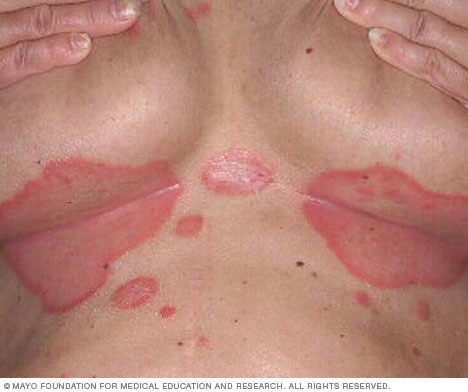
Inverse psoriasis
Inverse psoriasis causes smooth patches of inflamed skin in the folds of the skin. It usually appears under the breasts and around the groin and buttocks.
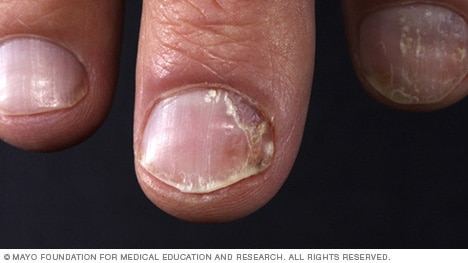
Nail psoriasis
Psoriasis can affect fingernails and toenails, causing pitting, abnormal nail growth and discoloration.
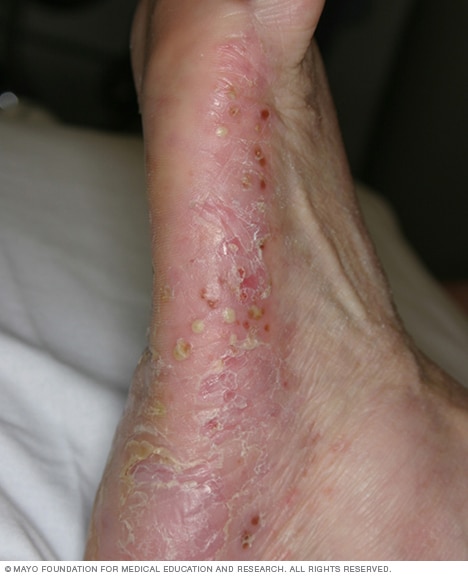
Pustular psoriasis
Pustular psoriasis generally develops quickly, with pus-filled blisters appearing just hours after the skin becomes inflamed and tender. It usually appears on the palms or the soles.
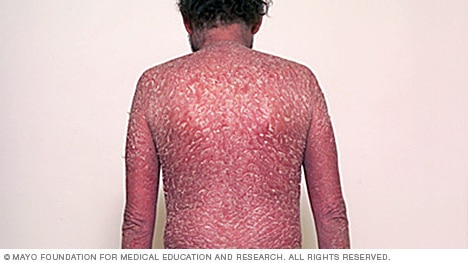
Erythrodermic psoriasis
The least common type of psoriasis, erythrodermic psoriasis can cover the entire body with a peeling, itchy rash.
When to see a doctor
If you suspect that you may have psoriasis, see your health care provider. Also seek medical care if your condition:
- Becomes severe or widespread
- Causes you discomfort and pain
- Causes you concern about the appearance of your skin
- Doesn't improve with treatment
Causes
Psoriasis is thought to be an immune system problem that causes skin cells to grow faster than usual. In the most common type of psoriasis, known as plaque psoriasis, this rapid turnover of cells results in dry, scaly patches.
The cause of psoriasis isn't fully understood. It's thought to be an immune system problem where infection-fighting cells attack healthy skin cells by mistake. Researchers believe that both genetics and environmental factors play a role. The condition is not contagious.
Psoriasis triggers
Many people who are predisposed to psoriasis may be free of symptoms for years until the disease is triggered by some environmental factor. Common psoriasis triggers include:
- Infections, such as strep throat or skin infections
- Weather, especially cold, dry conditions
- Injury to the skin, such as a cut or scrape, a bug bite, or a severe sunburn
- Smoking and exposure to secondhand smoke
- Heavy alcohol consumption
- Certain medications — including lithium, high blood pressure drugs and antimalarial drugs
- Rapid withdrawal of oral or injected corticosteroids
Risk factors
Anyone can develop psoriasis. About a third of instances begin in childhood. These factors can increase the risk of developing the disease:
- Family history. The condition runs in families. Having one parent with psoriasis increases your risk of getting the disease. And having two parents with psoriasis increases your risk even more.
- Smoking. Smoking tobacco not only increases the risk of psoriasis but also may increase the severity of the disease.
From Mayo Clinic to your inbox
Sign up for free and stay up to date on research advancements, health tips, current health topics, and expertise on managing health. Click here for an email preview.
Complications
If you have psoriasis, you're at greater risk of developing other conditions, including:
- Psoriatic arthritis, which causes pain, stiffness, and swelling in and around the joints
- Temporary skin color changes (post-inflammatory hypopigmentation or hyperpigmentation) where plaques have healed
- Eye conditions, such as conjunctivitis, blepharitis and uveitis
- Obesity
- Type 2 diabetes
- High blood pressure
- Cardiovascular disease
- Other autoimmune diseases, such as celiac disease, sclerosis and the inflammatory bowel disease called Crohn's disease
- Mental health conditions, such as low self-esteem and depression

CON-20257388
Mayo Clinic does not endorse companies or products. Advertising revenue supports our not-for-profit mission.
Advertising & Sponsorship
Mayo Clinic Press
Check out these best-sellers and special offers on books and newsletters from Mayo Clinic Press.
