Kyphosis Symptoms and causes
Overview
Kyphosis is a condition in which the back curves forward, causing a rounded back.
In older adults, kyphosis often happens when the bones of the spine become weak. They start to compress or fracture. Other types of kyphosis can happen in infants or teenagers. These types are usually caused by issues with how the spine forms or by spinal bones that slowly become wedge-shaped over time.
Mild kyphosis may cause few or no symptoms. More-serious kyphosis can lead to pain and changes in appearance. Treatment depends on your age and the cause and severity of the spinal curve.
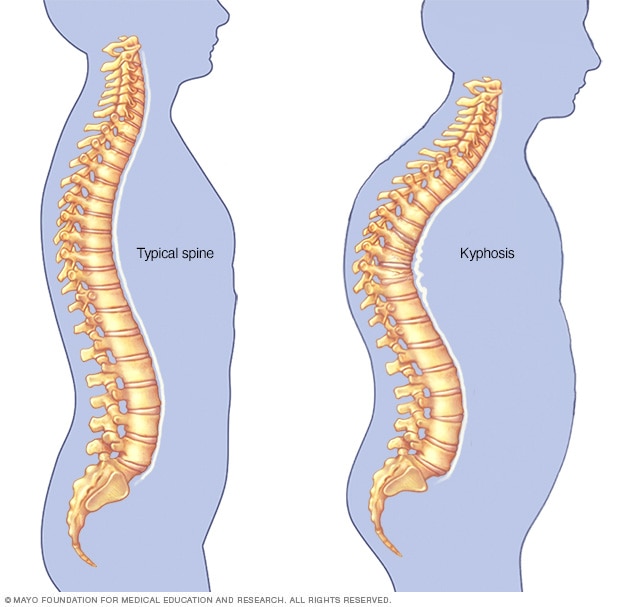
Kyphosis
An increased front-to-back curve of the spine is called kyphosis.
Mayo Clinic Health Letter & Books
Join thousands of readers who trust Mayo Clinic Health Letter for reliable health tips and insights. Start your journey to better health today.
Symptoms
Mild kyphosis may not cause any noticeable symptoms. It is typical for the upper back to have a slight curve. However, too much curvature can lead to back pain and difficulty standing upright.
When to see a doctor
Make an appointment with your healthcare professional if you notice that the curve in your upper back is getting worse. Contact your child's healthcare professional if you see an increased curve in your child's spine.
Causes
In a healthy spine, each vertebra is shaped like a cylinder, with the front and back about the same height. This allows the spine to stack evenly and stay upright.
In kyphosis, the vertebrae become wedge-shaped. This means the front of the bone becomes shorter than the back, forming a triangle shape. When several vertebrae take on this shape, the spine may tilt forward. Over time, this causes the back to curve and appear rounded.
The shape of vertebrae can be changed by:
- Fractures. Broken vertebrae can cause the spine to curve forward.
- Compression fractures. These are the most common type of fracture. They often happen in weakened bones and can happen with no known injury. Mild compression fractures may not cause noticeable symptoms.
- Osteoporosis. Osteoporosis weakens bones. This can lead to spinal curvature, especially when compression fractures happen. Osteoporosis is most common in older women and in people who have used corticosteroids for a long time.
- Disk degeneration. Soft, round disks between the vertebrae act as cushions. As you age, these disks can flatten and shrink, which may worsen kyphosis.
- Scheuermann disease. Also called Scheuermann kyphosis, this condition typically appears during adolescence.
- Other issues. Vertebrae that do not form properly before birth can cause kyphosis. In children, kyphosis also may be linked to certain medical conditions.
Risk factors
The risk of developing kyphosis in adulthood increases with age. As people get older, bone strength lessens and spinal disks wear down. In children, certain conditions can raise the risk of kyphosis. These include osteogenesis imperfecta, cerebral palsy, Scheuermann's disease, Ehlers-Danlos syndrome and Marfan syndrome.
Complications
In addition to causing back pain, kyphosis may cause:
- Limited physical function. Kyphosis can weaken back muscles and make everyday activities harder. The condition can make walking or standing up from a chair difficult. The spinal curve also may make it hard to look upward, drive or lie flat without pain.
- Digestive problems. Serious kyphosis can press on the digestive tract. This can lead to problems such as acid reflux or trouble swallowing.
- Back pain. Some people with serious kyphosis have ongoing back pain.
- Body image issues. People with kyphosis, especially teenagers, may feel self-conscious about having a rounded back.
CON-20374188
Mayo Clinic does not endorse companies or products. Advertising revenue supports our not-for-profit mission.
Advertising & Sponsorship
Mayo Clinic Press
Check out these best-sellers and special offers on books and newsletters from Mayo Clinic Press.
