Frozen shoulder Diagnosis and treatment
Diagnosis
During a physical exam, a healthcare professional may ask you to move your arm in certain ways. This is to check for pain and see how far you can move your arm. How far you can move your arm on your own is called active range of motion. Then you may be asked to relax your muscles while your healthcare professional moves your arm, called passive range of motion. Frozen shoulder affects both active and passive range of motion.
Frozen shoulder can usually be diagnosed with symptoms alone. But imaging tests, such as X-rays, ultrasound or MRI, can rule out other conditions.
Treatment
Most frozen shoulder treatment involves controlling shoulder pain and keeping as much range of motion in the shoulder as possible.
Medications
Pain relievers you can buy without a prescription, such as aspirin and ibuprofen (Advil, Motrin IB, others), can help reduce pain and inflammation associated with frozen shoulder. Sometimes, a healthcare professional may prescribe stronger pain-relieving and anti-inflammatory drugs.
Therapies
A physical therapist can teach you range-of-motion exercises to help you move your shoulder better. Doing these exercises regularly is important to help your shoulder get back to as much movement as possible.
Surgery or other procedures
Most frozen shoulders get better on their own over time. But if symptoms are serious or don't go away, other treatment options may help:
Steroid shots, also called injections. Shots of corticosteroids in the shoulder joint may help lessen pain and improve shoulder movement, especially if given soon after frozen shoulder begins.
- Hydrodilation. This procedure involves gently injecting sterile water into the shoulder joint to expand and stretch the shoulder joint capsule. This may help make it easier to move the joint. Sometimes, this is combined with a steroid shot. This procedure involves a medicine called a general anesthetic, so you'll be asleep and feel no pain. Then your healthcare professional moves the shoulder joint in different directions to help loosen the tightened tissue.
- Shoulder manipulation under anesthesia. This procedure involves a medicine called a general anesthetic, so you'll be asleep and feel no pain. Then your healthcare professional moves the shoulder joint in different directions to help loosen the tightened tissue.
- Surgery. Surgery for frozen shoulder is rare. But if nothing else helps, surgery can remove scar tissue from inside the shoulder joint. This surgery usually involves making small incisions for instruments guided by a tiny camera inside the joint. This is called shoulder arthroscopy.
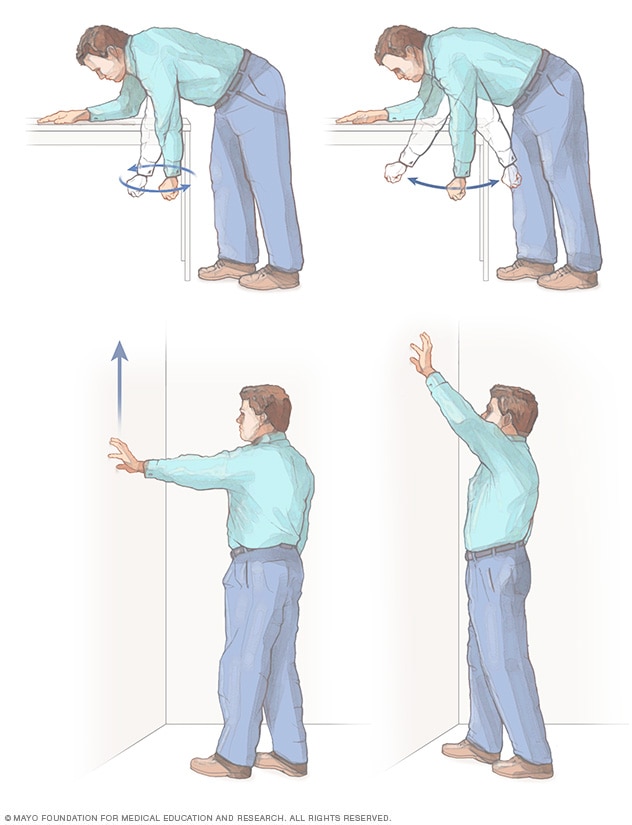
Shoulder exercises
These exercises may improve the shoulder's range of motion. Let your arm hang down like a pendulum, and then gently swing it back and forth or in circles. Pretend your fingers are your feet and walk your fingers up a wall.
Alternative medicine
Acupuncture
Acupuncture uses hair-thin, flexible needles put into the skin at certain points on the body. Typically, the needles remain in place for 15 to 40 minutes. The needles typically are not put in very far. Most acupuncture treatments are painless.
Nerve stimulation
A transcutaneous electrical nerve stimulation unit, also called a TENS unit, delivers a tiny electrical current to key points on a path that a nerve follows. The current, delivered through electrodes taped to the skin, isn't painful or harmful. It's not known exactly how TENS works. It might block fibers that carry pain. Or it might cause the release of molecules that lessen pain, called endorphins.
Self-care
Continue to use the shoulder and arm as much as possible given your pain and range-of-motion limits. Applying heat or cold to your shoulder can help relieve pain.
Preparing for your appointment
You may start by seeing your regular healthcare professional. Your healthcare professional may refer you to a doctor who specializes in treating bones, joints and muscles, called an orthopedist. Or you could be referred to a doctor who focuses on physical rehabilitation, called a physiatrist.
What you can do
Before your appointment, try to gather:
- A complete description of your symptoms and when they started.
- Information about any past heath issues you've had.
- Information about health issues in your blood relatives, such as your parents or siblings.
- A list of all the medicines and supplements you take.
- Questions to ask your healthcare professional.
What to expect from your doctor
To better understand your condition, your healthcare professional may ask:
- What makes your symptoms worse?
- Have you ever injured this shoulder? If so, how?
- Do you have diabetes?
- Have you had recent surgeries or times when you had to keep your shoulder still for a while?
CON-20372667
Mayo Clinic does not endorse companies or products. Advertising revenue supports our not-for-profit mission.
Advertising & Sponsorship
Mayo Clinic Press
Check out these best-sellers and special offers on books and newsletters from Mayo Clinic Press.
