Eye melanoma Diagnosis and treatment
Diagnosis
Eye melanoma diagnosis often starts with an eye exam. Imaging tests can help show the size of the cancer.
Eye exam
During an eye exam for eye melanoma, a healthcare professional may first examine the outside of the eye. The health professional may look for blood vessels that are larger than usual. Large blood vessels might mean there's something concerning happening inside the eye.
An eye exam also involves looking inside the eye with the help of special equipment. One way to do that uses lenses and a bright light mounted on a healthcare professional's forehead. This is called binocular indirect ophthalmoscopy. Another method uses lenses and a microscope that has an intense beam of light that lights up the inside of the eye. This is called slit-lamp biomicroscopy.
Fundus photography
Fundus photography is a test that takes color pictures of the inside surface of the eye. This part of the eye is called the fundus. Fundus photography can show an eye melanoma. The test might be repeated to watch a melanoma over time. Different kinds of tests can take pictures of the fundus to show an eye melanoma. One example is fundus autofluorescence.
Eye ultrasound
An eye ultrasound uses high-frequency sound waves to make images of the eye. The sound waves come from a device that looks like a wand, called a transducer. A healthcare professional places the transducer on the closed eyelid or on the front surface of the eye to get the pictures.
Eye angiography
Angiography is a test that makes pictures of the blood vessels. To get pictures of the blood vessels in the eye, a colored dye is injected into a vein in an arm. The dye travels to the blood vessels in the eye. A camera with special filters to detect the dye takes pictures of the eye every few seconds for several minutes. Tests that can make pictures of the blood vessels in the eye include fluorescein angiography and indocyanine green angiography.
Optical coherence tomography
Optical coherence tomography is an imaging test that uses light waves to make pictures of the eye. It can make pictures of the uvea and the retina that might show an eye melanoma.
Eye melanoma biopsy
A biopsy is a procedure to remove a sample of tissue for testing in a lab. A biopsy typically isn't necessary to diagnose eye melanoma. But it may be used in some situations. Sometimes a biopsy may be done at the time of treatment to get more information about the cancer cells.
Testing for cancer spread
Other tests may be needed to see if melanoma has spread to other parts of the body. The tests may include:
- Blood tests.
- Tests to check how well the liver works.
- Chest X-ray.
- Ultrasound.
- Computerized tomography scan, also called CT scan.
- Magnetic resonance imaging, also called MRI.
- Positron emission tomography scan, also called PET scan.
Treatment
Not all eye melanomas need treatment. When treatment is needed, it can include radiation therapy, laser therapy, photodynamic therapy or surgery. Targeted therapy and immunotherapy may be used to treat eye melanoma in some situations.
Which treatment is best for eye melanoma depends on several factors. These factors include the size and location of the cancer. Treatment also depends on whether cancer has spread beyond the eye. Your overall health and what you prefer to do is part of treatment planning too.
Waiting to treat small eye melanomas
A small eye melanoma may not need to be treated right away. If the melanoma is small and isn't growing, you and your healthcare professional might choose to wait and watch for signs of growth.
If the melanoma grows or causes other health concerns, you may choose to have treatment at that time.
Radiation therapy for eye melanoma
Radiation therapy treats cancer with powerful energy. Radiation therapy is typically used for small to medium-sized eye melanomas.
For eye melanoma, radiation therapy often involves placing a radioactive device on the eye. The device is called a plaque. It looks like a bottle cap. The plaque holds several radioactive seeds. A healthcare professional places the plaque on the eye, over the cancer. The plaque is held in place with temporary stitches. The plaque stays in place for a few days. Then it's removed. Radiation treatment that involves putting the radiation inside the body is called brachytherapy.
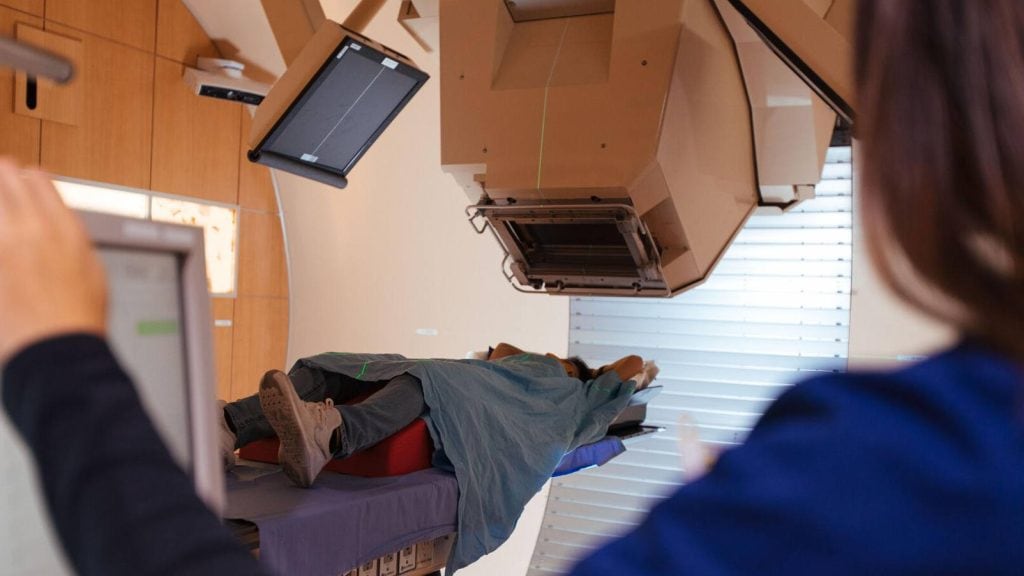
The radiation also can come from a machine that aims beams of radiation, such as proton beams. The beams can be aimed at the eye to treat eye melanoma. Giving radiation with a machine outside the body is called external beam radiation. This type of radiation therapy often is given over several days.
Laser therapy for eye melanoma
Laser therapy uses a laser light to hurt the cancer cells. For eye melanoma, it might be used in some situations. One type of laser treatment, called thermotherapy, uses an infrared laser. It's sometimes used along with radiation therapy to treat eye melanoma.
Photodynamic therapy for eye melanoma
Photodynamic therapy is a two-stage treatment that combines light energy with a medicine called a photosensitizer. The photosensitizer kills cancerous and precancerous cells when activated by light, usually from a laser. For eye melanoma, photodynamic therapy is used for smaller cancers.
Surgery for eye melanoma
Surgery to treat eye melanoma may involve removing the melanoma or removing the entire eye.
- Surgery to remove the melanoma. Surgery to remove the melanoma and a band of healthy tissue around it may be an option for treating some small eye melanomas.
-
Surgery to remove the eye. Surgery to remove an eye is called enucleation. It may be used for some large eye melanomas.
After the eye with melanoma is removed, an implant often is put into the same place. The muscles that control the movement of the eye are attached to the implant. That allows the implant to move. After the eye has time to heal, an artificial eye, called a prosthesis, is made that matches the other eye.
Targeted therapy for eye melanoma
Targeted therapy for cancer is a treatment that uses medicines that attack specific chemicals in the cancer cells. By blocking these chemicals, targeted treatments can cause cancer cells to die. For eye melanoma, targeted therapy may be used when the cancer has spread to other parts of the body or in situations where surgery isn't possible.
Immunotherapy for eye melanoma
Immunotherapy for cancer is a treatment with medicine that helps the body's immune system kill cancer cells. The immune system fights off diseases by attacking germs and other cells that shouldn't be in the body. Cancer cells survive by hiding from the immune system. Immunotherapy helps the immune system cells find and kill the cancer cells. For eye melanoma, immunotherapy may be used when the cancer has spread to other parts of the body or in situations where surgery isn't possible.
Clinical trials
Explore Mayo Clinic studies testing new treatments, interventions and tests as a means to prevent, detect, treat or manage this condition.
Coping and support
Coping with vision changes
If cancer treatment causes total loss of vision in one eye, it's still possible to do most things you were able to do when you could see with both eyes. But it may take several months to get used to the new way of seeing.
Having only one eye affects the ability to judge distance. And it may be harder to be aware of things around you. That's especially true of things that happen on the side where you no longer have vision.
An occupational therapist can help you learn ways to cope with a change in vision. A support group also may be helpful. Ask your healthcare professional for recommendations.
Preparing for your appointment
Start by seeing your primary healthcare professional if you have any symptoms that worry you. If your healthcare professional suspects you have an eye problem, you may be referred to a doctor who specializes in eye care, called an ophthalmologist.
If you have eye melanoma, you may be referred to a doctor who specializes in eye cancer, called an ocular oncologist. This doctor can explain your treatment options and may refer you to other specialists depending on the treatments you choose.
Appointments may be short, so it's a good idea to be prepared. Here's some information to help you get ready.
What you can do
- Be aware of anything you need to do before your appointment. When you make the appointment, ask if there's anything you need to do to get ready.
- Write down any symptoms you have. Include any that may not seem related to the reason why you scheduled the appointment.
- Write down key personal information. Include any major stresses or recent life changes. Family medical history also can be helpful.
- Make a list of all medicines, vitamins or supplements that you take.
- Consider taking a family member or friend along. Sometimes it can be hard to remember all the information you get during an appointment. Someone who comes with you may remember something that you missed or forgot.
- Write down questions to ask your healthcare professional.
Bringing a list of questions to your appointment can help you make the most of the time with your healthcare professional. For eye melanoma, some basic questions to ask include:
- Do I have eye melanoma?
- Where is the eye melanoma located?
- What is the size of the eye melanoma?
- Has the eye melanoma spread beyond my eye?
- Will I need additional tests?
- What are my treatment options?
- Can treatments cure the eye melanoma?
- What are the potential side effects of each treatment?
- Do I have to have treatment?
- How long can I take to decide on a treatment?
- Is there one treatment you feel is best for me?
- How will treatment affect my daily life?
- How will treatment affect my vision?
- I have other health conditions. How can I best manage them along with eye melanoma?
- Should I see other specialists?
- Are there brochures or other printed material that I can take with me? What websites do you recommend?
Don't hesitate to ask other questions you may have too.
What to expect from your doctor
Your healthcare professional is likely to ask you some questions, including:
- When did you start having symptoms?
- Do you have symptoms all the time, or do they come and go?
CON-20372355
Mayo Clinic does not endorse companies or products. Advertising revenue supports our not-for-profit mission.
Advertising & Sponsorship
Mayo Clinic Press
Check out these best-sellers and special offers on books and newsletters from Mayo Clinic Press.
