
Overview
Mild cognitive impairment is the in-between stage between typical thinking skills and dementia. The condition causes memory loss and trouble with language and judgment, but it doesn't affect daily activities.
People with mild cognitive impairment, also known as MCI, may be aware that their memory or mental ability has changed. Family and close friends also may notice changes. But these changes aren't bad enough to impact daily life or affect usual activities.
MCI raises the risk of developing dementia caused by Alzheimer's disease or other brain conditions. But for some people with mild cognitive impairment, symptoms might never get worse or even get better.
Symptoms
Symptoms of mild cognitive impairment, also known as MCI, include trouble with memory, language and judgment. The symptoms are more serious than the memory issues that are expected as people get older. But the symptoms don't affect daily life at work or at home.
The brain, like the rest of the body, changes with age. Many people notice they become more forgetful as they age. It may take longer to think of a word or to recall a person's name. But if concerns with memory go beyond what's expected, the symptoms may be due to mild cognitive impairment.
People with MCI may have symptoms that include:
- Forgetting things more often.
- Missing appointments or social events.
- Losing their train of thought. Or not following the plot of a book or movie.
- Trouble following a conversation.
- Trouble finding the right word or with language.
- Finding it hard to make decisions, finish a task or follow instructions.
- Trouble finding their way around places they know well.
- Poor judgment.
- Changes that are noticed by family and friends.
People with MCI also may experience:
- Depression.
- Anxiety.
- A short temper and aggression.
- A lack of interest.
When to see a doctor
Talk to your healthcare professional if you or someone close to you notices changes in memory or thinking. This may include forgetting recent events or having trouble thinking clearly.
Causes
There's no single cause of mild cognitive impairment. In some people, mild cognitive impairment is due to Alzheimer's disease. But there's no single outcome. Symptoms may remain stable for years or they may improve over time. Or mild cognitive impairment may progress to Alzheimer's disease dementia or another type of dementia.
Mild cognitive impairment, also known as MCI, often involves the same types of brain changes seen in Alzheimer's disease or other dementias. But in MCI, the changes occur at a lesser degree. Some of these changes have been seen in autopsy studies of people with mild cognitive impairment.
These changes include:
- Clumps of beta-amyloid protein, called plaques, and neurofibrillary tangles of tau proteins that are seen in Alzheimer's disease.
- Microscopic clumps of a protein called Lewy bodies. These clumps are related to Parkinson's disease, dementia with Lewy bodies and, sometimes, Alzheimer's disease.
- Small strokes or less blood flow through brain blood vessels.
Brain-imaging studies show that the following changes may be related to MCI:
- Decreased size of the hippocampus, an area of the brain important for memory.
- Larger size of the brain's fluid-filled spaces, known as ventricles.
- Reduced use of glucose in key brain areas. Glucose is the sugar that is the main source of energy for cells.
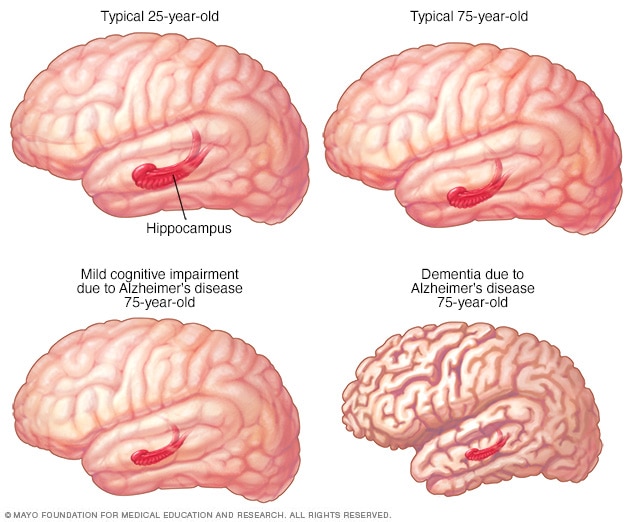
Changes in brain structure with MCI and Alzheimer's disease
Some changes in brain structure are typical with aging. For example, the size of the brain's memory center, known as the hippocampus, gets smaller with age. But the reduction in size is greater in those with mild cognitive impairment and even more dramatic in people with Alzheimer's disease.
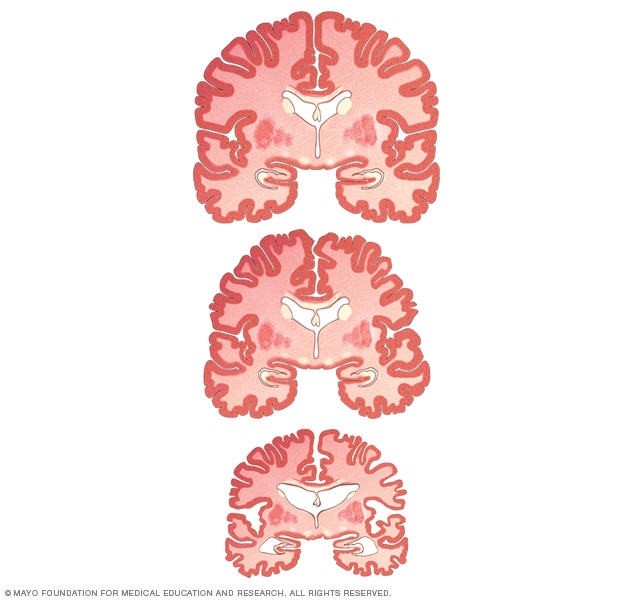
Brain shrinkage in MCI and Alzheimer's disease
Dementia causes the brain to lose mass, especially in critical areas. Note the difference in size between a healthy brain (top), a mild cognitive impairment brain (middle) and an Alzheimer's disease brain (bottom).
Risk factors
The strongest risk factors for mild cognitive impairment are:
- Older age.
- Having a form of a gene known as APOE e4. This gene also is linked to Alzheimer's disease. But having the gene doesn't guarantee a decline in thinking and memory.
Other medical conditions and lifestyle factors have been linked to a higher risk of changes in thinking, including:
- Diabetes.
- Smoking.
- High blood pressure.
- High cholesterol, especially high levels of low-density lipoprotein, known as LDL.
- Obesity.
- Depression.
- Obstructive sleep apnea.
- Hearing loss and vision loss that are not treated.
- Traumatic brain injury.
- Lack of physical exercise.
- Low education level.
- Lack of mentally or socially stimulating activities.
- Exposure to air pollution.
Complications
Complications of mild cognitive impairment include a higher risk — but not a certainty — of dementia. Overall, about 1% to 3% of older adults develop dementia every year. Studies suggest that around 10% to 15% of people with mild cognitive impairment go on to develop dementia each year.
Prevention
Mild cognitive impairment can't be prevented. But research has found that some lifestyle factors may lower the risk of getting it. These steps may offer some protection:
- Don't drink large amounts of alcohol.
- Limit exposure to air pollution.
- Reduce your risk of a head injury, such as by wearing a helmet when riding a motorcycle or bicycle.
- Don't smoke.
- Manage health conditions such as diabetes, high blood pressure, obesity and depression.
- Watch your levels of low-density lipoprotein (LDL) cholesterol and get treatment if the levels are high.
- Practice good sleep habits and manage any sleep conditions.
- Eat a healthy diet full of nutrients. Include fruits and vegetables and foods low in saturated fats.
- Stay social with friends and family.
- Get moderate to vigorous exercise most days of the week.
- Wear a hearing aid if you have hearing loss.
- Get regular eye exams and treat any vision changes.
- Stimulate your mind with puzzles, games and memory training.