
Diagnosis
An exam will include a general physical. Your healthcare professional also will typically ask about your symptoms, diet, lifestyle habits and medical history.
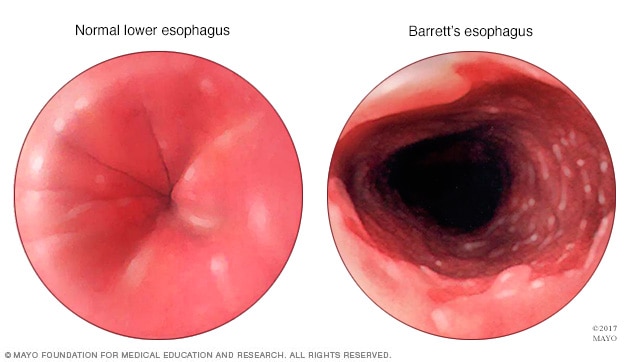
A procedure called endoscopy is used to determine if you have Barrett's esophagus. An endoscope is a flexible tube with a light and camera that transmits images to a screen. A health professional passes the tube down your throat and into the esophagus. A probable diagnosis of Barrett's esophagus can often be suggested based on the appearance of the esophageal lining during the exam. A lab test is used to confirm it.
An endoscope also has a tool to remove small tissue samples, called biopsies, that are examined in a lab. A health professional who specializes in examining tissues, called a pathologist, can confirm that cells from a biopsy of the esophagus have undergone changes seen in Barrett's esophagus.
Determining cancer risk
Pathologists also will look for irregular cells that could lead to cancer. The presence of these precancerous cells is called dysplasia. A diagnosis of dysplasia requires lab exams by two pathologists, including one who specializes in diseases of the digestive system.
The findings are classified as one of the following:
- Indefinite for dysplasia means that it's not certain if any changes in cells are precancerous.
- Low-grade dysplasia is the presence of some precancerous cells that suggest an increased risk of developing cancer.
- High-grade dysplasia is the presence of many precancerous cells and a greater risk of cancer.
Screening for Barrett's esophagus
The American College of Gastroenterology (ACG) recommends screening for Barrett's esophagus in people who have long-term GERD and three or more risk factors for Barrett's esophagus:
- Male.
- Over age 50.
- White racial identity.
- Tobacco smoking.
- Obesity.
- Parents or siblings with Barrett's esophagus or esophageal cancer.
Screening for Barrett's esophagus is usually done with endoscopy.
Another screening test involves drinking water to swallow a capsule attached to a string. When the capsule dissolves, a tiny sponge is released. When the sponge is pulled back up with the string, it collects tiny samples that can be studied in a lab.
Barrett's esophagus diagnosis
Barrett's esophagus has a distinct appearance when viewed during an endoscopy exam. During endoscopy, a healthcare professional passes a flexible tube with a video camera at the tip, called an endoscope, down your throat and into the swallowing tube, also called the esophagus. The video camera can show surface irregularities, such as acid reflux damage, the presence of a hiatal hernia or ulcers, as well as Barrett's esophagus.
Treatment
Treating GERD
Most people with Barrett's esophagus are prescribed medicines called proton pump inhibitors (PPIs). The medicines make the contents of the stomach less acidic. Stomach contents will still flow back into the esophagus, but there may be less damage to the lining of the esophagus. This treatment may allow tissues to heal.
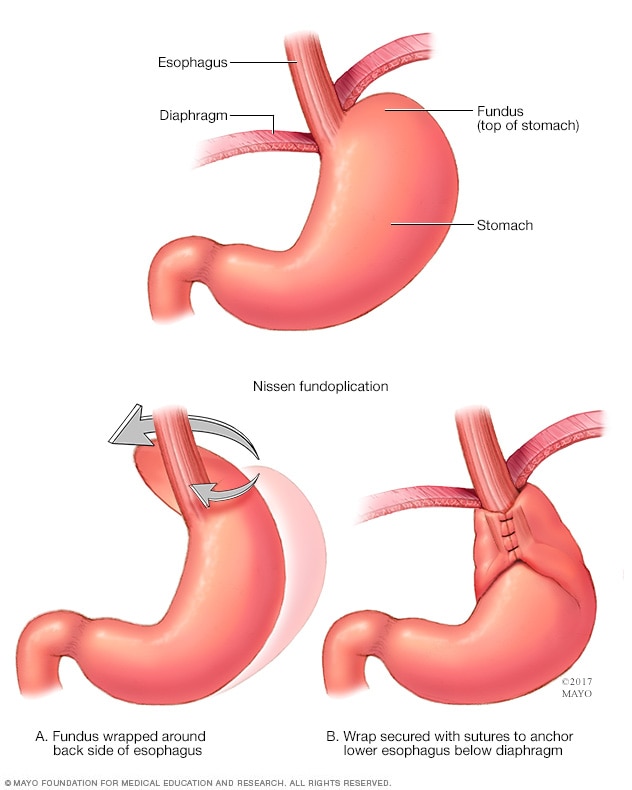
A surgery called Nissen fundoplication may be recommended if there's no improvement in symptoms or tissue health after taking PPIs for a long period and after making changes in diet and lifestyle habits. In this procedure, the top portion of the stomach is wrapped around the lower part of the esophagus. This reinforces the valve between the esophagus and stomach and helps prevent acid reflux.
GERD surgery
Antireflux surgery for GERD may involve a procedure called Nissen fundoplication. In this procedure, the surgeon wraps the top of the stomach around the lower esophagus. This reinforces the lower esophageal sphincter, making it less likely for acid to back up into the esophagus.
Treatments to reduce cancer risk
Other interventions are meant to screen for and reduce the risk of cancer. The management plan varies depending on cancer risk.
Indefinite for dysplasia
Your healthcare professional will likely recommend endoscopy with a biopsy within one year after a diagnosis of Barrett's esophagus. If there is no sign of dysplasia, the test is repeated in 3 to 5 years.
Low-grade dysplasia
Low-grade dysplasia is an early stage of precancerous changes in cells. Your healthcare professional may recommend a regular endoscopy to monitor your condition. The test may be repeated as often as every six months.
Other options are procedures to remove or destroy irregular tissues from the lining of the esophagus. Procedures may include the following.
- Endoscopic resection uses an endoscopic tool to cut out irregular tissues that are visible with the endoscope. These tissues are examined in a lab for precancerous or cancerous cells.
- Radiofrequency ablation uses an endoscope to apply heat to destroy irregular esophagus tissue. This procedure is often used after a resection to ensure the destruction of precancerous cells.
- Cryotherapy ablation also uses an endoscope to apply a cold liquid or gas to destroy irregular tissues, usually after a resection.
High-grade dysplasia
High-grade dysplasia is the presence of many precancerous cells and is linked to a greater risk of cancer. Your healthcare professional may recommend endoscopic resection, radiofrequency ablation or cryoablation to remove irregular tissues.
In rare cases, a section of the esophagus may be removed. This procedure is called an esophagectomy. Tissues from elsewhere in the body are used to replace the removed section.
Self-care
Lifestyle changes can ease symptoms of GERD. Your healthcare professional will likely recommend the following:
- Maintaining a healthy weight.
- Eliminating foods and drinks that trigger your heartburn, such as chocolate, coffee, alcohol and mint.
- Stopping smoking.
- Raising the head of your bed. Place wooden blocks under your bed to elevate your head.
Ask your healthcare professional about services and programs to help you reach these treatment goals.
Preparing for your appointment
Barrett's esophagus is most often diagnosed in people with GERD who are being examined for GERD complications. If your healthcare professional discovers Barrett's esophagus on an endoscopy exam, you may be referred to a doctor who treats digestive diseases, called a gastroenterologist.
What you can do
- Be aware of any pre-appointment restrictions, such as not eating solid food on the day before your appointment.
- Write down your symptoms, including any that may seem unrelated to the reason why you scheduled the appointment.
- Make a list of all your medicines, vitamins and supplements; the doses; and the reason for taking each one.
- Write down your key medical information, including other conditions.
- Ask a relative or friend to accompany you to help you remember what your healthcare professional says.
- Write down questions to ask your healthcare professional.
Questions to ask your doctor
- Do my lab reports show precancerous changes? If so, what is the grade of my dysplasia?
- How much of my esophagus is affected?
- How often should I be screened for changes to my esophagus?
- Do I have dysplasia? Was the diagnosis confirmed by an expert in gastrointestinal pathology?
- What's my risk of esophageal cancer?
- What are the treatment options?
- Do I need to make diet or other lifestyle changes?
- I have other health conditions. How can I best manage these conditions together?
In addition to the questions that you've prepared to ask your doctor, don't hesitate to ask additional questions during your appointment.
What to expect from your doctor
Be ready to answer the following questions:
- When did you first begin experiencing symptoms?
- Are your symptoms continuous or occasional?
- What, if anything, seems to worsen your symptoms? Does anything make your symptoms better?
- Do you experience heartburn or other symptoms of acid reflux?
- Do you take any medicines for acid reflux or indigestion?
- Do you have difficulty swallowing?
- Have you lost weight?