Overview
Vasectomy reversal is surgery to undo a vasectomy. During the procedure, a surgeon reconnects the tube called the vas deferens that carries sperm from a testicle into the semen. After a successful vasectomy reversal, sperm are present in the semen, making it possible for pregnancy to happen.
Vasectomy reversal success rates depend on a number of important factors. These include your age, how long it has been since your vasectomy, and whether you or your partner had fertility issues before the vasectomy. A surgeon's training and experience with microsurgical vasectomy reversal also play a major role in improving success rates and the chance of pregnancy.
Products & Services
Why it's done
A vasectomy reversal typically is done to achieve a pregnancy. But for some people, vasectomy reversal may be used to treat chronic testicular pain after a vasectomy.
Our caring team of Mayo Clinic experts can help you with your health concerns. Get started at Mayo Clinic Men's Health.
Get care now
Risks
Almost all vasectomies can be reversed. But the procedure doesn't guarantee pregnancy or the ability to have a child.
A vasectomy often can be reversed many years after the original procedure, even 20 years or more. But the longer it has been since a vasectomy, the more likely it is that scar tissue or a blockage has developed. When this happens, a more complex repair, called vasoepididymostomy, may be needed. Because this procedure is more technically demanding and because it often is needed due to a long-standing blockage, overall vasectomy reversal success rates tend to go down as more time passes since the vasectomy.
Vasectomy reversal rarely leads to serious health issues, called complications. Risks include:
- Bleeding within the scrotum. This can lead to a collection of blood, called a hematoma, that causes painful swelling. Following your healthcare team's directions after surgery can lower the risk of getting a hematoma. Those directions may include resting, using scrotal support and applying ice packs after surgery. Ask a member of your healthcare team if you need to stop taking aspirin or other types of blood-thinning medication before and after surgery.
- Infection at the surgery site. Although they are not common after vasectomy reversal, infections are a risk with any surgery. If you get an infection, you may need treatment with antibiotics.
- Chronic pain. Pain that lasts a long time after vasectomy reversal is possible, but it's not common.
How you prepare
When considering vasectomy reversal, here are a few things to think about:
- Vasectomy reversal may be expensive, and your insurance might not cover it. Find out about costs ahead of time.
- Vasectomy reversals are generally most successful when they're done by a surgeon who is trained in and uses microsurgical techniques, including those that use a surgical microscope.
- The procedure is most successful when performed by a surgeon who does the procedure regularly and who has done the procedure many times.
- Sometimes a more complex type of repair, called a vasoepididymostomy, is needed. Be sure that your surgeon can perform this procedure.
When choosing a surgeon, ask:
- How many vasectomy reversals has the surgeon done?
- What type of techniques does the surgeon use?
- How often have the surgeon's vasectomy reversals resulted in pregnancy?
Also be sure you know the risks and possible complications of a vasectomy reversal.
Food and medicines
Ask what steps you need to take before surgery, such as not eating or drinking for a certain amount of time. Your healthcare team will likely ask you to stop taking some medicines before surgery. Examples include blood-thinning medicines and some pain relievers, such as aspirin or ibuprofen (Advil, Motrin IB, others), because they can raise the risk of bleeding.
Clothing and personal items
Bring a tight-fitting undergarment, such as an athletic supporter, to wear after surgery. It will help support your scrotum and hold bandages in place.
Other preparation
Have someone available to drive you home after surgery. A vasectomy reversal generally takes about 2 to 4 hours or longer. You may need more time to recover if the procedure is done with general anesthesia. Most people go home the same day.
What you can expect
Vasectomy reversal
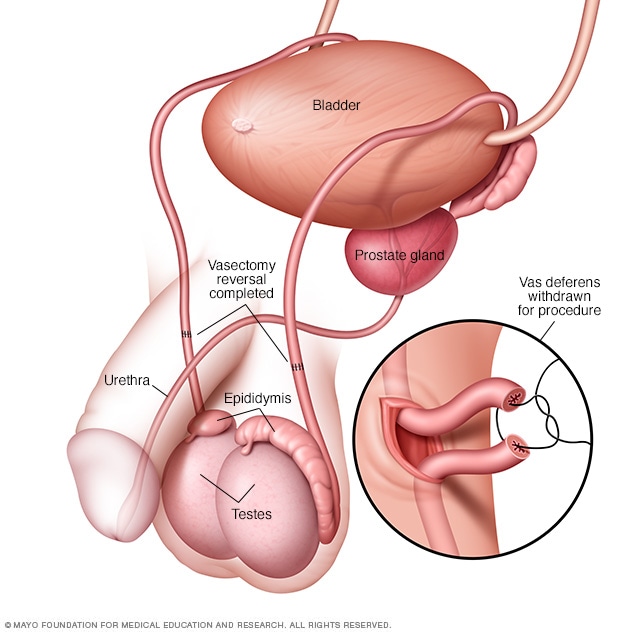
Vasectomy reversal
A vasectomy reversal reconnects the sperm-carrying tube that gets cut during vasectomy surgery. This tube is called the vas deferens. During vasectomy reversal, a surgeon reattaches the cut ends of the vas deferens. In some cases, the vas deferens may be attached directly to the epididymis, which is the part of the testicle where sperm matures and is stored.
Before the procedure
Before vasectomy reversal surgery, your healthcare professional will likely:
- Talk with you about your medical history and do a physical exam. This can help make sure that you don't have health concerns that could make the surgery more complex.
-
Check to see whether you can make healthy sperm. After a vasectomy, the testicles keep making sperm. But the amount of sperm typically goes down over time. Age, diet, exercise, smoking and other things can change how much healthy sperm the body makes.
Blood tests before surgery can check to see whether you still can make healthy sperm. The tests involve checking the levels of testosterone and follicle-stimulating hormone (FSH). These blood tests may be recommended before vasectomy reversal for people who have symptoms of low testosterone, who haven't had biological children or whose vasectomy was done more than 10 years ago.
Depending on your situation, it may be useful for your partner to have fertility tests before you have a vasectomy reversal to confirm that pregnancy is possible. Female partners should consider seeing a fertility specialist if they:
- Are 35 or older.
- Have periods that aren't regular.
- Don't have periods.
- Have a history of pelvic infections or endometriosis.
- Have had pelvic surgery in the past.
- Have been told they may have fertility issues.
An evaluation can help identify any issues early and guide a plan for achieving pregnancy.
Vasectomy reversals typically are done at a surgery center or hospital. They are generally done on an outpatient basis, which means you don't have to stay overnight. Some surgeons can do the surgery at a clinic. But be sure that the surgeon can do a more complex repair, called a vasoepididymostomy, in that setting, if it's needed.
For the surgery, you're given medicine called anesthetic to control pain. The kind you get typically depends on how complex your surgery is and what the surgeon prefers. General anesthesia puts you to sleep during surgery. Local anesthesia keeps you from feeling pain but doesn't put you to sleep.
Doing a vasectomy reversal is harder than doing a vasectomy. Because of that, it needs to be done using microsurgery. Microsurgery uses a powerful surgical microscope to magnify the vas deferens as much as 40 times its size. This type of surgery requires specialized skills and expertise.
During vasectomy reversal, a surgeon reattaches the tube that carries sperm, called the vas deferens, in one of two ways:
- Vasovasostomy (vas-o-vay-ZOS-tuh-me). With this approach, the surgeon sews back together each vas deferens.
- Vasoepididymostomy (vas-o-ep-ih-did-ih-MOS-tuh-me). With this approach, the surgeon attaches the vas deferens directly to the small organ at the back of each testicle that holds sperm, called the epididymis. This surgery is more complex than a vasovasostomy. In general, it's done if a vasovasostomy can't be done or isn't likely to work.
Most of the time, it's not possible to know before surgery which procedure is needed. Typically, the surgeon decides during surgery which technique to use. Sometimes a combination of the two is needed. That might mean a vasovasostomy is done on one side and a vasoepididymostomy on the other. The longer it has been since a vasectomy, the more likely it is that a vasoepididymostomy will be needed on one or both sides.
During the procedure
During surgery, the surgeon makes a small cut, called an incision, on the scrotum. This exposes the vas deferens and releases it from nearby tissues.
Next, the surgeon cuts open the vas deferens and looks at the fluid inside. If sperm are in the fluid, the ends of the vas deferens can be connected to allow a passageway for the sperm.
If there's no sperm in the fluid, scar tissue may be blocking the tube. In that situation, the surgeon may choose to do a vasoepididymostomy instead.
Sometimes, robot-assisted surgery is used for vasectomy reversal. But it's not often needed.
After the procedure
When surgery is done, the surgeon covers the incision with bandages. You put on a tight-fitting undergarment, such as an athletic supporter. Ask a member of your healthcare team when you may take off the bandages. Stitches should dissolve in 7 to 10 days.
After you get home, don't do any activities that could cause the testicles to move a lot. As the anesthetic wears off, you may have some pain and swelling. Put ice on the surgical area for 24 to 48 hours to ease swelling. You may be sore for several days. For most people, the pain isn't serious, and it typically gets better after a few days to a week.
Your healthcare team also may give you the following directions:
- For the first two days after surgery, don't do anything that might get the surgery site wet, such as bathing or swimming.
- If you have a desk job, you'll probably be able to go back to work a few days after surgery. If your job involves physical labor or requires a lot of walking or driving, ask a member of your healthcare team about when it's safe to go back to work.
- For several weeks after surgery, wear an athletic supporter except when showering. After that, wear one when you exercise for 4 to 6 weeks.
- For at least 6 to 8 weeks after surgery, limit any activities that may pull on the testicles or scrotum, such as jogging, biking or heavy lifting.
- Don't have sex or ejaculate until your healthcare professional says it's OK. For most people, this is about 2 to 3 weeks after surgery.
Freezing sperm
Although typically it's not needed, you may choose to freeze sperm in case vasectomy reversal doesn't work. That procedure is called cryopreservation. If pregnancy doesn't happen after a vasectomy reversal, you may be able to use frozen sperm to have a child through other methods, such as in vitro fertilization.
Narrator: A vasovasostomy is one surgical procedure used to reverse a vasectomy. The animation provides a brief overview of the relevant anatomy with the vas deferens, prior vasectomy site, epididymis and testicle highlighted. The procedure is performed by placing the patient under anesthesia after which a midline scrotal incision is made in the scrotum. This is usually not much bigger than is required to perform the original vasectomy. The segment of vas deferens that was previously blocked or transected at the time of the initial vasectomy is identified, brought through the surgical wound and resected. After this, the fluid is sampled from the testicular end of the open vas deferens. This fluid is then analyzed under a microscope to determine if any sperm are present. In this particular case, an abundant number of motile sperm are visualized. This would suggest that we can proceed with reattachment of the vas deferens directly. To accomplish the reattachment, initial stitches are initially placed to re-approximate the vas deferens. After this step, several intraluminal smaller sutures are placed to bring the lumen of the vasa together. Additional sutures are then placed to completely enclose the opening of the vas and final supporting sutures are placed to reinforce the newly attached vas deferens. Once the sutures are tied, the final connection is complete and the vas deferens is returned to its normal location. The animation demonstrates the final result of a vasovasostomy.
Narrator: In certain conditions, a more complex reconstruction is required known as an epididymovasostomy or vasoepididymostomy. The animation provides a brief overview of the relevant anatomy with the vas deferens, prior vasectomy site, epididymis and testicle highlighted. This procedure begins in a similar manner to a vasovasostomy. A midline scrotal incision is made after which the obstructed vasal segment is removed and the fluid on the testicular side is sampled under microscopy. In this particular case, microscopic analysis does not demonstrate the presence of any sperm. In that scenario, we would proceed with an epididymovasostomy. The scrotal midline incision is extended after which the testicle is delivered through the wound. This permits better visualization of the epididymis. Next, the epididymis is incised and an obstructed epididymal tubule is selected for anastomosis. The vas deferens is brought down to the level of the epididymis and secured using some initial stitches. Two double-armed smaller sutures are then placed into the epididymal tubule after which the epididymal tubule is incised. The fluid is again sampled and this time demonstrates the presence of normal sperm. Once sperm are identified, the stitches are then placed inside the lumen of the vas deferens and the vas deferens is tied down to the epididymal tubule. Additional stitches are then placed to secure the vas deferens to the epididymal sheath for additional strength. This final animation demonstrates the post-operative result with the attachment of the vas deferens to the epididymis directly.
Results
After a vasectomy reversal, your healthcare professional may look at your semen under a microscope to see whether the surgery was successful. Other than pregnancy, the only way to tell if the vasectomy reversal worked is to check semen for sperm.
When a vasectomy reversal is successful, sperm may show up in the semen within a few weeks. But sometimes it can take a year or more. Sometimes, sperm may return after a vasectomy reversal but later drop to zero. This may happen about 6 to 12 months after surgery if scar tissue forms at the connection site and blocks the flow of sperm. This type of scarring happens in about 15% of people who have vasectomy reversal.
Vasectomy reversal does not guarantee pregnancy. Even if sperm return to the semen after surgery, pregnancy depends on several factors, including sperm quality and a female partner's fertility.
If the vasectomy reversal doesn't work
Sometimes, reversals fail because of an issue with the testicles that the surgeon can't see during surgery, or if the tubes get blocked again. Some people try a second vasectomy reversal if the first one doesn't work. The chance of success is lower for a second surgery than it is for the first.
You also may be able to have a child through in vitro fertilization by using frozen sperm. Sperm may be taken at the time of the reversal surgery or at a later date. In general, many healthcare professionals don't recommend freezing sperm at the time of a vasectomy reversal because often it's an extra step in the surgery that's not needed.
Oct. 30, 2026