Risks
Lumpectomy is generally safe, but possible risks include:
- Bleeding.
- Infection.
- Pain or tenderness in the breast.
- Short-term swelling or bruising.
- A buildup of fluid near the surgical area, called a seroma.
- A scar or changes in breast shape or appearance.
- Breast lymphedema, which is swelling caused by fluid buildup.
Some people develop nerve-related pain that lasts after breast-conserving surgery. This may feel like burning, shooting pain, electric shocks or increased skin sensitivity.
Another possible outcome is a positive margin. This means that cancer cells are found at the edge of the removed tissue. If this happens, another surgery may be needed to remove more tissue so that no cancer cells are found at the edge.
How you prepare
To prepare for lumpectomy, you'll likely meet with a surgeon. The surgeon may talk about treatment options based on your type of cancer, health and preferences. Bring a list of questions. This can help you cover everything you want to know. Make sure you understand the procedure and its risks.
Your healthcare team may give you instructions about things you need to know before surgery. The surgery is usually done as an outpatient procedure. This means you typically can go home the same day.
In general, to prepare for your surgery, your care team will likely advise that you:
- Tell the team about any medicines, vitamins or supplements you're taking. Some medicines and supplements may affect surgery, anesthesia or healing.
- Ask when to stop certain medicines. Your healthcare team tells you whether and when to stop glucagon-like peptide 1 (GLP-1) medicines, aspirin or other blood-thinning medicines before surgery.
- Stop smoking or using nicotine. Nicotine can slow healing and increase the risk of infection. If you are planning oncoplastic breast reconstruction, your surgical team may require you to stop using all nicotine products for six weeks before surgery.
- Stop eating before surgery. You receive specific instructions from your healthcare team about eating. You may need to stop eating several hours before surgery. Your team may tell you that you can drink certain liquids until a specific time. Follow the instructions the team gives you.
- Make a plan for after surgery. After a lumpectomy, many people can go home the same day. But the need for an overnight stay depends on the procedures done and recovery after surgery. Arrange for someone to go with you to surgery and drive you home.
What you can expect
Before the procedure
If the area to be removed is hard to feel or cannot be felt, you may have a procedure called localization before surgery. Localization uses imaging to mark the area to help the surgeon find it during the lumpectomy.
A healthcare professional who specializes in imaging, called a radiologist, uses mammography, ultrasound or another imaging test to locate the area. The radiologist then places a small device in or near the area to mark its location. The device may be a thin wire, radioactive seed, magnetic seed, radar reflector or another type of localization device.
The surgeon uses this marker as a guide during the lumpectomy. The localization procedure may be done on the day of surgery or earlier, depending on the type of device used. If the lump can be easily felt or identified with ultrasound, you may not need localization.
Sentinel lymph node surgery
Sentinel node biopsy
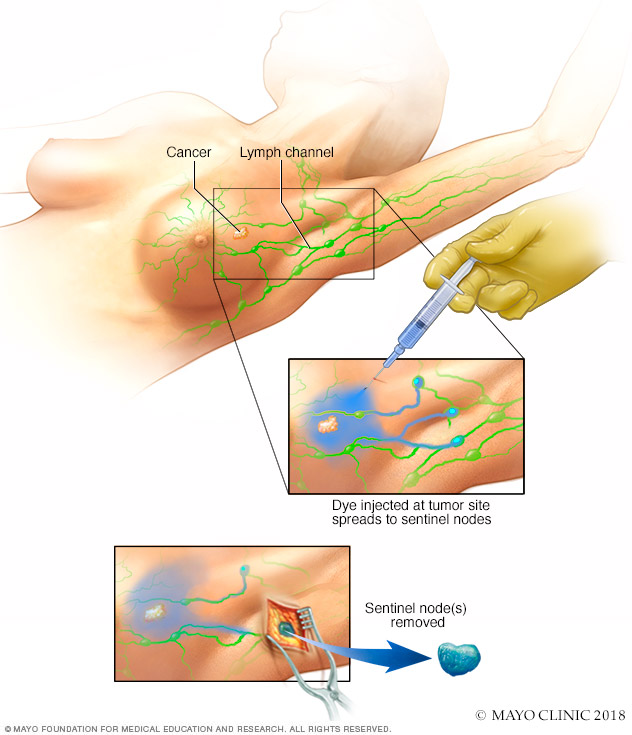
Sentinel node biopsy
Sentinel node biopsy identifies the first few lymph nodes into which a tumor drains. The surgeon uses a harmless dye and a weak radioactive solution to locate the sentinel nodes. The nodes are removed and tested for signs of cancer.
The sentinel lymph nodes are the first underarm nodes to receive drainage from the breast. They typically are where cancer spreads first.
During a lumpectomy, your surgeon may remove some of these sentinel nodes to check for cancer cells. This is a procedure called sentinel lymph node surgery or sentinel lymph node biopsy.
To help the surgeon find the sentinel lymph nodes, a radioactive tracer, contrast material or both are injected into the breast. This material travels with fluid through a network of vessels and lymph nodes called the lymphatic system. It collects in the first few lymph nodes that drain the breast, helping the surgeon find them.
The surgeon removes these nodes through a separate incision under the arm. Other lymph nodes that look or feel concerning also may be removed. Sometimes, the lumpectomy incision is used to take out the nodes.
If the sentinel lymph nodes do not contain cancer cells, more lymph nodes usually do not need to be removed.
If the sentinel lymph nodes contain cancer cells, you may need more surgery to remove underarm lymph nodes. This surgery is called axillary dissection. Some people have cancer cells in only one or two sentinel lymph nodes. If radiation therapy will follow the surgery, they may not need surgery to remove more lymph nodes.
During the procedure
A lumpectomy is usually done under general anesthesia. General anesthesia uses medicine to put you into a sleeplike state during the procedure. You aren't aware during the surgery, and the anesthesia prevents you from feeling pain. A team of healthcare professionals gives the general anesthetics. The team might include an anesthesiologist and a nurse anesthetist. The team watches you closely during the surgery.
Your care team also might put medicine that causes numbness into the breast. This medicine, called a local anesthetic, helps decrease pain in the breast.
The surgeon makes an incision in the breast. The surgeon removes the cancer and some surrounding tissue.
After taking out the cancer, the surgeon reshapes the remaining breast tissue. For oncoplastic reshaping, the surgeon may rearrange tissue within the breast or use tissue from another area to help restore breast shape.
The breast tissue removed during surgery goes to a lab for testing. In the lab, a doctor who specializes in analyzing cells and tissue, called a pathologist, examines the tissue. If later testing finds cancer cells at the edge of the removed tissue, you may need another surgery to remove more tissue.
The surgeon may place small metallic clips at the site where the cancer was removed. These clips can help guide radiation therapy by marking the area where the tumor was removed.
The surgeon closes the incisions with stitches that usually dissolve over time and do not require removal. Your surgeon also may place thin adhesive strips or use glue on the incision to keep it closed until it heals.
Lumpectomy typically takes 1 to 2 hours.
After the procedure
After the procedure, your healthcare team takes you to a recovery area. Your team watches you closely as you come out of your sleeplike state. Most people leave the hospital on the day of surgery. Your healthcare team decides whether it's safe for you to go home.
Managing pain
You may have some discomfort after surgery. Your healthcare team might recommend medicine you can buy without a prescription to help with the discomfort. Follow your healthcare team's instructions.
Sometimes, stronger pain medicine is needed. Tell your healthcare team if you have pain. Applying ice to the painful area also might help.
Some people feel burning or shooting pain in the breast after surgery. This may be nerve-related pain. Tell your healthcare team about pain that is severe, gets worse or lasts longer than expected.
Instructions for home
Your healthcare team gives you instructions for caring for yourself at home. The team might go over these instructions with you and the person who helps you get home after surgery. Instructions from your healthcare team might include:
- How to take care of the surgery area.
- What medicines to use for pain.
- When to start taking your usual medicines again.
- Limits on your activity as you recover.
- Symptoms or changes that may mean there is a complication.
- How to contact your healthcare team.
- A list of your next medical appointments.
Returning to activities
Most people can return to light activities within a few days. Within about two weeks, most people can return to their usual activities. Recovery may take longer depending on the amount of tissue removed and whether lymph node surgery or oncoplastic surgery was done at the same time.
Ask your healthcare team how much time you may need away from work. The timing may depend on how you feel, how much surgery you had, and whether your work involves lifting or strenuous activity.
Your healthcare team tells you when you can drive again. Do not drive while taking pain medicine that affects your alertness. You also need to be able to move your arm comfortably, control the vehicle and drive safely.
Ask when you can return to lifting, exercise and other strenuous activities. Also ask when it is safe to swim, soak in a bathtub or use a hot tub. When you can return to activities depends on how the incision is healing and the extent of your surgery.
Breast care
Your healthcare team may tell you to wear a supportive surgical bra during recovery. Ask the team how long to wear it.
You may have swelling, bruising or tenderness in the breast while it heals. A buildup of fluid near the surgery area, called a seroma, also can occur.
You will likely have a scar where the surgeon made the incision. The breast also may have a dent or another change in shape where tissue was removed. These changes may be more noticeable when a larger amount of tissue is removed.
Results
The breast tissue removed during lumpectomy is sent to a lab for testing. The pathologist examines the tissue and prepares a report. The pathology report may include the type and grade of the cancer, whether cancer cells are found at the edges of the removed tissue, and whether any lymph nodes contain cancer.
Preparing the final pathology report usually takes several days. The report is often available within 10 days after surgery. It may take longer if additional testing is needed.
Surgical margins
The edges of the removed tissue are called surgical margins. A negative margin means that the pathologist did not find cancer cells at the edge of the tissue. A positive margin means that cancer cells were found at the edge.
If the margins are positive, another surgery may be needed to remove more tissue from the positive margin. Sometimes a mastectomy may be recommended.
For invasive breast cancer treated with lumpectomy, the margin generally is considered clear when no cancer cells are found at the outer edge of the removed tissue. In the lab, that edge is marked with ink to help the pathologist examine it.
For ductal carcinoma in situ (DCIS) treated with lumpectomy, a margin of 2 millimeters generally is considered clear. A margin narrower than 2 millimeters does not automatically mean that more surgery or a mastectomy is needed.
The healthcare team considers the pathology findings and other factors when deciding whether you need more surgery.
Next steps
Your healthcare team reviews the pathology results with you and explains whether more surgery or other treatment is recommended. The results help guide decisions about radiation therapy, chemotherapy, estrogen blocker therapy and targeted therapy.
Most people have radiation therapy after healing from lumpectomy. Radiation therapy helps lower the risk that cancer will return in the same breast. Some people with early-stage invasive breast cancer or DCIS may be able to have radiation directed only to the area of the breast where the cancer was removed rather than to the whole breast.
Your follow-up plan may include breast exams and mammograms to look for cancer returning in the treated breast or developing in the other breast.
Clinical trials
Explore Mayo Clinic studies of tests and procedures to help prevent, detect, treat or manage conditions.