Overview
Laminectomy
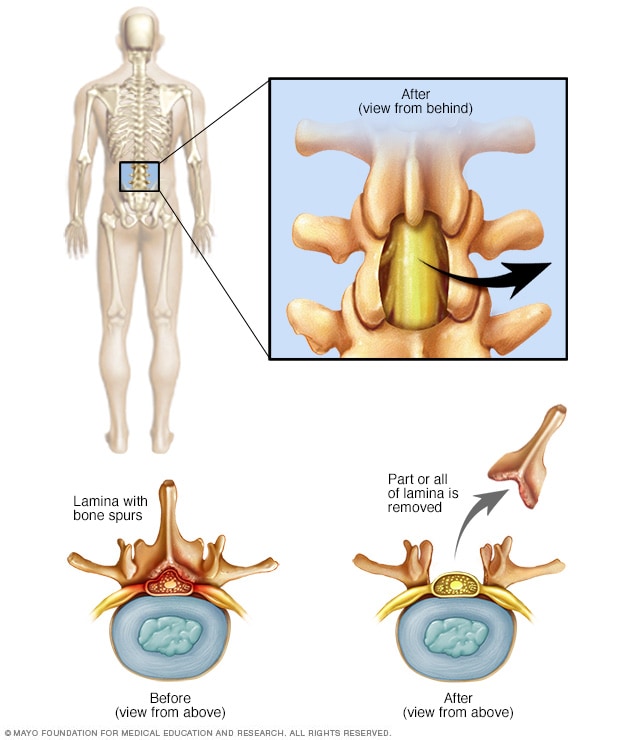
Laminectomy
A lumbar laminectomy involves taking out the back part of a spinal bone, called the lamina, in the lower back to make more room in the spinal canal.
Cervical laminectomy
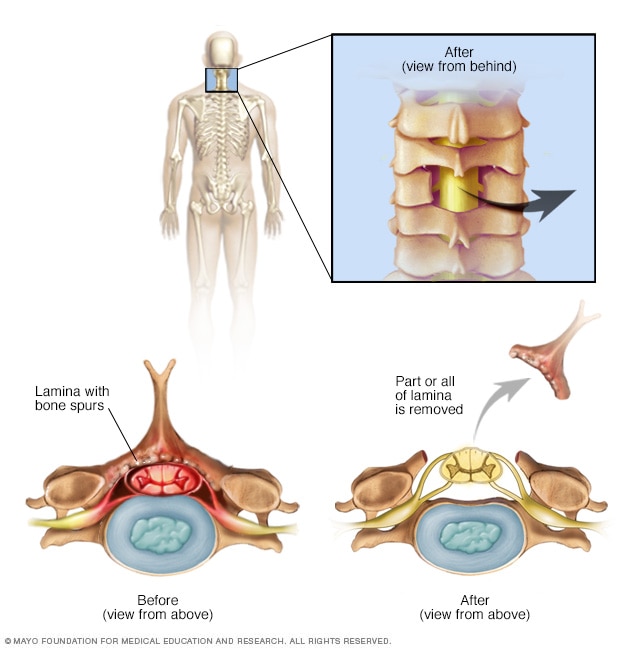
Cervical laminectomy
A cervical laminectomy involves taking out the back part of a spinal bone, called the lamina, in the neck to make more room in the spinal canal.
Laminectomy is surgery to remove the back part of a spinal bone, also called a vertebra. The back part of this bone is called the lamina. It covers the spinal canal. The spinal canal is a ring of bone that houses the spinal cord and nerve roots. If that ring becomes too small for the spinal cord or nerve roots to have enough space to work well, it is called spinal stenosis. Removing some or all of the lamina makes more room in the spinal canal. This can lessen pressure on the spinal cord or spinal nerves. Laminectomy also is called spinal decompression surgery.
Pressure in the spinal canal is often caused by extra bone, herniated disks, cysts, and thickened ligament tissue that develops with aging and arthritis of the spine. The extra bone may be called degenerative spondylosis, degenerative arthritis or bone spurs. Some people may be more likely to develop narrowing because they were born with a smaller spinal canal or because of other spine changes. This is called congenital stenosis.
Laminectomy typically is done only after other treatments have not helped enough. Other treatments may include medicines, physical therapy or injections. Laminectomy might be recommended if symptoms are severe or getting worse.
Why it's done
Bony growths, bulging disks, cysts and thickened ligaments can form and build up inside the spinal canal. These changes narrow the space for the spinal cord or nerves. This narrowing is called spinal stenosis.
The pressure from spinal stenosis can cause pain, weakness, numbness or tingling. These symptoms may travel down the arms or legs, depending on which part of the spine is affected.
Symptoms may get worse when you stand up straight. They may get better when you lean forward or sit. This is because standing upright naturally makes the spinal canal a little narrower. If you already have spinal stenosis, standing up straight can make the narrowing worse.
Laminectomy makes more room in the spinal canal. This can ease pressure that causes pain that travels down an arm or leg. But laminectomy does not cure the arthritis or other spine changes that caused the narrowing. For that reason, it may not relieve pain felt only in the back or neck.
Your healthcare team may recommend laminectomy if:
- Other treatments, such as medicines, physical therapy or injections, have not helped enough.
- Muscle weakness, numbness or pain makes it hard to stand or walk.
- Symptoms include loss of bowel or bladder control.
Sometimes laminectomy may be done as part of surgery to treat a herniated spinal disk. A surgeon may need to remove part of the lamina to reach the damaged disk.
Risks
Laminectomy is generally safe. But complications can occur with any surgery, and some can be serious. Possible complications include:
- Bleeding.
- Infection.
- Blood clots.
- Nerve injury.
- A leak of spinal fluid.
The chance of complications depends on many factors, including your age, overall health and whether you smoke. The risk depends on whether other procedures, such as spinal fusion, are done at the same time. Talk with your care team about the risks for you.
How you prepare
Your care team gives you instructions before surgery. You may need to avoid eating and drinking for a certain amount of time before surgery. You also may be told which medicines to take or stop taking before the procedure.
Plan for someone to take you home from the hospital. Ask your care team when you might be able to return to work, and when you can drive, lift, exercise and do other daily activities.
What you can expect
During laminectomy
Surgeons typically perform laminectomy using general anesthesia, so you are not awake during the surgery.
The surgical team monitors heart rate, blood pressure and blood oxygen levels throughout the procedure. After you are asleep and can't feel pain:
- The surgeon makes a cut, also called an incision, over the affected vertebrae. The surgeon moves muscles away from the spine as needed.
- The surgeon uses small tools to remove bone spurs, thickened tissue and the smallest amount of lamina needed to relieve pressure.
- If laminectomy is done as part of surgery for a herniated disk, the surgeon also removes the herniated part of the disk and any loose pieces. This is called a diskectomy.
- If a vertebra has slipped over another vertebra or if the spine needs more stability, spinal fusion may be done. During spinal fusion, the surgeon joins two or more vertebrae together. This surgery may involve bone grafts and metal rods or screws.
- The surgeon may perform minimally invasive surgery, depending on your condition and your needs. Minimally invasive surgery uses smaller incisions and special tools. Evidence comparing minimally invasive laminectomy with standard laminectomy is still evolving. Your surgeon can discuss which option fits your situation.
After laminectomy
After surgery, you are moved to a recovery room. The care team watches for complications from surgery and anesthesia. You may be asked to move your arms and legs. You may receive medicine to relieve pain at the incision site.
Most people go home the day of surgery. Others stay in the hospital for one or more nights. The timing depends on your health and the details of the surgery. If you also have spinal fusion, recovery typically takes longer.
Your care team may recommend physical therapy after laminectomy. Physical therapy can help improve strength and flexibility. Before you leave the hospital or surgery center, the care team gives you instructions about wound care, medicines and activity limits. You'll also get information about follow-up appointments and when to get medical help.
Depending on the amount of lifting, walking and sitting your job involves, you may be able to return to work within a few weeks. Your surgeon or care team gives you guidance based on your procedure and recovery.
Results
Most people have less pain in their leg or arm after laminectomy. Walking and standing may become easier. But results may vary. And benefits may lessen over time, especially if arthritis or other degenerative spine changes continue. Laminectomy is less likely to improve pain in the back or neck itself.
Talk with your surgeon about what results are realistic for you. Your outcome depends on the cause of the pressure, your symptoms, your overall health and whether other procedures are done at the same time.
Clinical trials
Explore Mayo Clinic studies of tests and procedures to help prevent, detect, treat or manage conditions.
Aug. 21, 2026