Overview
Prostate gland
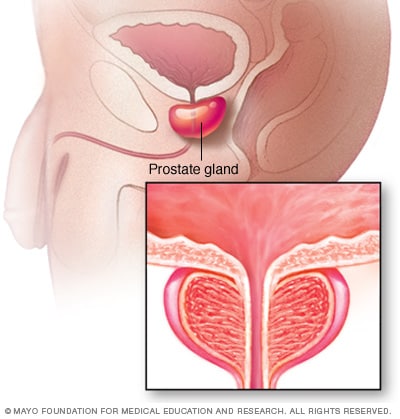
Prostate gland
The prostate gland sits just below the bladder. It surrounds the top part of the tube that drains urine from the bladder, called the urethra. The prostate's main job is to make the fluid that feeds and carries sperm, called seminal fluid. The prostate is part of the male reproductive system.
Holmium laser prostate surgery, also called holmium laser enucleation of the prostate (HoLEP), is a minimally invasive treatment for benign prostatic hyperplasia. Benign prostatic hyperplasia, also called BPH, is a condition that causes the prostate to get larger than usual. When the prostate gets too large, it presses on the tube that carries urine out of the body, called the urethra. This can block the flow of urine.
HoLEP uses a laser to remove prostate tissue so that urine can flow freely. Another tool is then used to cut the prostate tissue into smaller pieces so that they can be easily removed.
HoLEP and traditional prostate surgery have some similarities, but there are differences. Traditional prostate surgery involves cuts to the skin, but no cutting is needed for HoLEP. HoLEP can provide quick relief from BPH symptoms. The removed tissue also can be looked at in a lab for other conditions, such as prostate cancer.
HoLEP offers faster recovery and symptom relief than traditional prostate surgery. Rarely, a second HoLEP procedure may be needed.
Read more about benign prostatic hyperplasia (BPH) and prostate laser surgery.
Products & Services
Why it's done
Holmium laser prostate surgery is done to treat benign prostatic hyperplasia, also called BPH. The surgery also is referred to as HoLEP. HoLEP often is used to improve urinary symptoms of BPH, such as:
- Feeling the need to urinate often.
- Difficulty urinating fully.
- Slow urine stream.
- Urinary tract infections, also called UTIs.
- Urinating often at night.
Your healthcare professional may recommend this treatment if you have an enlarged prostate and you:
- Are not able to completely empty your bladder.
- Have bladder stones.
- Have kidney failure.
- Have blood in your urine that doesn't get better with treatment.
- Get UTIs often.
- Have taken medicines for BPH but didn't get better.
- Have certain health conditions or take medicines that make traditional prostate surgery risky.
- Are at high risk of bleeding.
Risks
Although holmium laser prostate surgery is minimally invasive, complications can happen. Some possible risks of treatment include:
- Bleeding, although the risk is lower than with traditional prostate surgery.
- Trouble urinating right after the procedure, which usually gets better with time.
- Leaking urine or loss of bladder control.
- Infection, including UTIs.
- Retrograde ejaculation, which happens when semen flows backward into the bladder during ejaculation.
- Narrowing of the tube that carries urine out of the body, called urethral stricture.
How you prepare
In the weeks leading up to your holmium laser prostate surgery, your healthcare professional will likely:
- Ask about your health history and current medicines. Your healthcare professional may recommend that you stop taking certain medicines, such as blood thinners. This can help reduce the risk of bleeding during surgery. Talk to your healthcare team about the medicines you take.
- Do a physical exam. This may include a rectal exam to feel the prostate. A rectal exam helps your healthcare professional understand the size and shape of your prostate.
- Order tests or imaging. You may need some tests before your procedure, such as blood tests, urine tests or other tests to check your bladder. Imaging tests, such as magnetic resonance imaging (MRI), computerized tomography (CT) or ultrasound may be used. Results of these tests help your healthcare professional better understand the size, shape and characteristics of your prostate.
- Talk about anesthesia options. Your healthcare professional also may discuss your options for anesthesia, such as general anesthesia or spinal anesthesia.
What you can expect
Holmium laser prostate surgery may require an overnight hospital stay. Even if you go home the same day, it's important to arrange for a ride. You won't be able to drive yourself home.
Before the procedure
You may be asked not to eat or drink anything for several hours before your procedure. A member of your care team will give you either general anesthesia or spinal anesthesia, depending on what your healthcare professional recommends.
With general anesthesia, you are in a sleeplike state. You won't see, feel or hear anything during the procedure. With spinal anesthesia, you will have no feeling in the lower part of your body. You may be partly awake, or you may have medicines to make you sleepy.
During the procedure
During the procedure, a thin tube with a light and camera is inserted through the tip of the penis into the urethra. This device is called a rectoscope. The holmium laser is then passed through the rectoscope. Heat from the laser cuts away extra prostate tissue that's blocking urine flow. The removed tissue falls into your bladder.
Then a special tool breaks up the tissues into smaller pieces, which are suctioned out of the bladder. If needed, a piece of tissue is sent to a lab and tested for other conditions, such as prostate cancer.
After the procedure
You might go home after the procedure. Or you may need to stay in the hospital overnight. A catheter placed in your bladder drains your urine. Your healthcare professional may flush fluid through the catheter to remove any blood. Usually, the catheter is taken out a day or two after your procedure.
You may notice urinary symptoms after HoLEP, such as:
- Mild pain or burning during urination.
- Blood in the urine.
- Trouble controlling your urine, such as leaking.
Typically, these symptoms are part of the healing process and get better as you recover.
Talk to your healthcare professional about any symptoms that bother you, get worse or don't get better with time. If you have lightheadedness, fever, chills or bleeding thick enough to block urine flow, get medical help right away.
Results
The results of holmium laser prostate surgery are similar to traditional prostate surgery in improving symptoms of benign prostatic hyperplasia, also called BPH. In fact, some research shows that HoLEP is better than traditional prostate surgery in improving BPH symptoms.
Compared with people who have traditional prostate surgery, people who have HoLEP may:
- Spend less time at the hospital.
- Have a catheter removed sooner.
- Have fewer bleeding complications after the procedure.
- Have faster symptom improvement.
Some BPH symptoms may improve soon after HoLEP, while other symptoms may improve in a few weeks or months. Sometimes a second HoLEP procedure is needed, but this is rare. See your healthcare professional if your urinary symptoms don't get better.
Clinical trials
Explore Mayo Clinic studies of tests and procedures to help prevent, detect, treat or manage conditions.
Dec. 16, 2025