Overview
Diskectomy
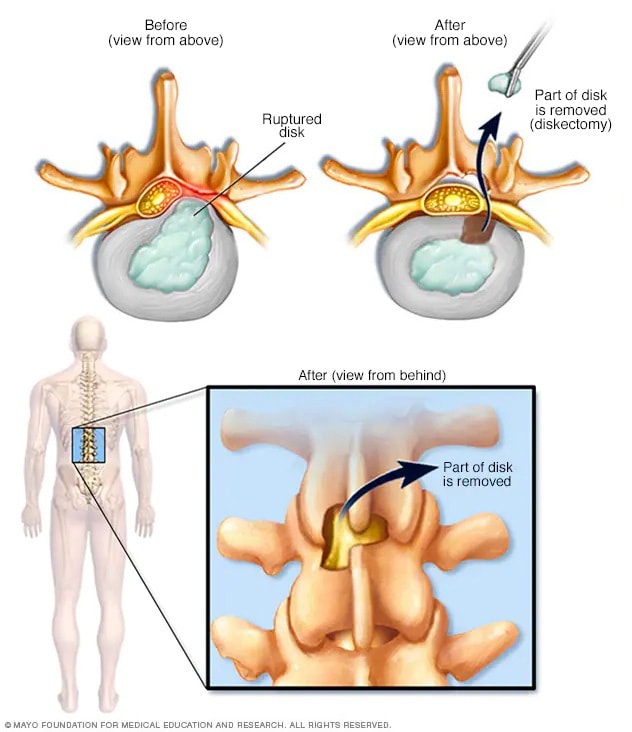
Diskectomy
Diskectomy is the surgical removal of the damaged portion of a herniated disk in the spine. A herniated disk occurs when some of the softer material inside a disk pushes out through a crack in the tougher outside of the disk. This can irritate or press on nearby nerves and cause pain, numbness or weakness.
Diskectomy is a surgery to remove the part of a spinal disk that has moved out of place and is pressing on a nerve. A spinal disk is a cushion between bones in the spine, called vertebrae. A disk that has moved out of place is called a herniated disk. It also may be called a slipped disk, ruptured disk, bulging disk, protrusion or disk prolapse.
Diskectomy surgery works best when a herniated disk causes pain, numbness or weakness that travels into an arm or leg. The surgery is less helpful for pain only in the back or neck. Diskectomy can be done with open surgery or with smaller cuts and special tools, including a microscope or video camera. This is called minimally invasive surgery.
Products & Services
Why it's done
Diskectomy is done to ease pressure on a spinal nerve caused by a herniated disk. A member of your healthcare team might suggest diskectomy if:
- Pain, numbness or weakness travels from the spine into an arm or leg and becomes hard to manage.
- Nerve weakness makes it hard to stand or walk.
- Symptoms get worse.
- Nonsurgical treatments, such as physical therapy, medicines or steroid shots, have not helped after about 6 to 12 weeks.
Seek medical care right away if you lose bladder or bowel control, have new trouble walking, or have new or worsening weakness in an arm or leg. These symptoms may be caused by pressure on nerves that needs urgent treatment.
Risks
Diskectomy is performed often, and serious complications are uncommon. But as with any surgery, diskectomy has risks.
Possible complications include bleeding, infection and a leak of spinal fluid. Spinal fluid also is called cerebrospinal fluid (CSF). A CSF leak is the most common complication of diskectomy. It happens in up to 14% of diskectomy surgeries. For most people, the leak can be repaired during surgery and does not affect long-term recovery.
Less common but serious complications include injury to blood vessels or nerves in or near the spine. Pain, numbness or weakness may be new or may continue after surgery.
Other risks include the disk herniating again, needing another surgery and risks related to anesthesia.
How you prepare
Follow the instructions from your healthcare team. You may need to stop eating and drinking for a certain amount of time before surgery.
Tell your care team about all medicines and supplements you take. If you take blood-thinning medicines, you may need to change how much you take before surgery. Do not stop taking any medicine unless your care team tells you to.
Because you may have anesthesia and may go home the same day, ask if you need to arrange for someone to drive you home. You also may need help at home while you recover.
What you can expect
During diskectomy
Surgeons typically do diskectomy while you are under general anesthesia. This means you are asleep and do not feel pain during surgery.
The goal is to remove only the part of the disk that is pressing on the nerve. Sometimes, the surgeon also needs to remove small amounts of bone or ligament to reach the herniated disk.
Diskectomy may be done in different ways. In a microdiskectomy, the surgeon uses a microscope and a smaller cut. In an endoscopic diskectomy, the surgeon uses a thin tube with a camera to see the affected area.
In some surgeries, especially in the neck, the whole disk may need to be removed as part of a fusion procedure. If this happens, the surgeon may fill the empty space with a bone graft or a synthetic bone substitute. The nearby spinal bones, called vertebrae, may be joined together. This is called fusion.
After diskectomy
After surgery, you are moved to a recovery room. Your healthcare team watches for complications from the surgery and anesthesia.
You may be able to go home the same day. Some people need a short hospital stay, especially if they have other medical conditions.
Your care team tells you when to start walking and when to return to daily activities. You may be told to limit bending, lifting and twisting for the first few weeks after surgery. Your care team may recommend physical therapy or a walking program.
When you can return to work depends on the type of surgery, your recovery and your job. If your job involves light lifting, walking or sitting, you may be able to return to work in 2 to 6 weeks. If your job involves heavy lifting or operating heavy machinery, you may need to wait 6 to 8 weeks before returning to work.
Results
Diskectomy lessens herniated disk symptoms for most people who have clear symptoms of a compressed nerve. These symptoms may include pain, numbness or weakness that travels into an arm or leg. Pain often improves first. Strength and sensation may take longer to improve.
Diskectomy may relieve symptoms faster than nonsurgical treatment. But pain relief may not last forever. Some people have symptoms again after surgery. Diskectomy also does not fix the reason the disk became injured or herniated in the first place.
To help protect your spine after surgery, it may help to:
- Stay at a healthy weight.
- Do low-impact exercises as you are told by your care team.
- Use safe lifting techniques.
- Limit repeated bending, twisting and lifting.
Aug. 21, 2026