What you can expect depends on how you and your surgery team decide to do your reconstruction. Breast reconstruction with flap surgery often starts right after mastectomy surgery. Some people choose to wait to have reconstruction surgery after they've healed from a mastectomy.
During breast reconstruction with flap surgery, a plastic surgeon transfers a section of skin, muscle, fat and blood vessels from one part of your body to your chest. The section of tissue is called a flap. The surgeon uses the flap to create a new breast mound. Some people also need a breast implant to get the breast size they want.
Tissue for reconstructing a breast most often comes from the belly. Surgeons also can use tissue from the thighs, back or buttocks. Your surgeon decides which method is best for you based on your body type and your medical and surgical history.
Types of flap surgery
Pedicle TRAM flap
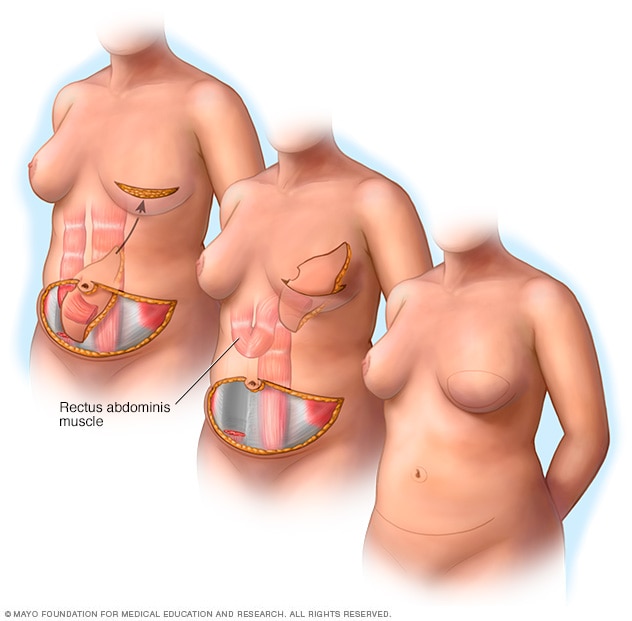
Pedicle TRAM flap
A pedicle transverse rectus abdominis muscle flap procedure uses muscle and tissue from the belly for the new breast. For this surgery, also called a pedicle TRAM flap procedure, the surgeon cuts a section of skin, muscle, fat and blood vessels from the belly. The surgeon then moves the tissue under the skin to the chest. The surgeon uses the tissue to form a new breast mound.
Free TRAM flap
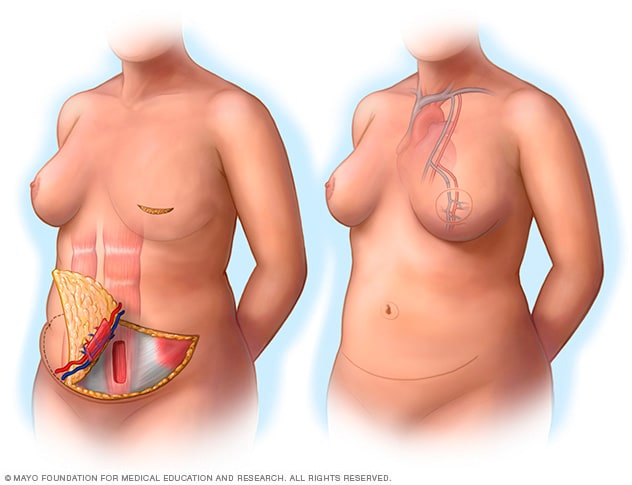
Free TRAM flap
A free transverse rectus abdominis muscle flap procedure uses a section of belly tissue that includes skin, fat and sometimes muscle for the new breast. For this surgery, also called a free TRAM flap procedure, the surgeon removes the tissue from its blood supply and attaches the tissue to blood vessels in the chest area. The surgeon uses the tissue to form a new breast mound.
Latissimus dorsi flap
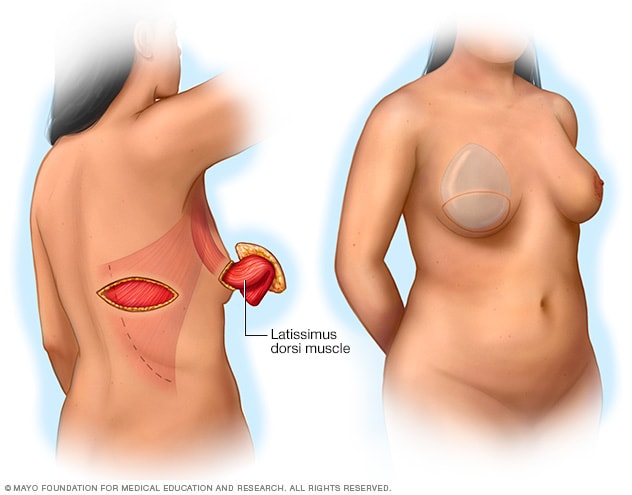
Latissimus dorsi flap
During latissimus dorsi flap surgery, the surgeon takes muscle and tissue from the back. The muscle used in this surgery is called the latissimus dorsi. The surgeon moves the tissue under the skin to its new place and uses it to form a new breast mound.
Kinds of tissue flaps commonly used for breast reconstruction include:
- Pedicle flap. A pedicle flap surgery involves moving tissue but keeps most blood vessels in place. The plastic surgeon cuts some of the blood vessels to the tissue for the reconstruction but keeps other blood vessels intact. The surgeon moves the tissue under the skin to the chest area. The surgeon then creates the new breast mound with the tissue.
- Free flap. A free flap surgery involves moving tissue and blood vessels. The plastic surgeon removes the tissue from its blood supply. The surgeon then attaches the tissue to new blood vessels near the chest. Because of the need to reattach blood vessels, free flap surgery most often takes longer than does surgery using a pedicle flap.
The tissue flap used in breast reconstruction with flap surgery needs good blood flow to help it survive. This surgery might not be a good choice if you have a condition that could cause blood flow problems. Examples include diabetes, vascular disease and connective tissue conditions. If you smoke, you need to quit before surgery. Your healthcare team may require that you stop smoking 4 to 6 weeks before your surgery.
TRAM flap
During transverse rectus abdominis muscle flap surgery, a plastic surgeon removes tissue with muscle from the belly. This procedure also is called TRAM flap surgery. The TRAM flap can be done as a pedicle flap or a free flap.
A pedicle TRAM flap uses the whole rectus muscle. The rectus muscle is one of the major abdominal muscles.
For a muscle-sparing free TRAM flap, a surgeon takes only a part of the rectus abdominis muscle. This may help you keep abdominal strength after surgery.
DIEP flap
Deep inferior epigastric perforator flap surgery, also called DIEP flap surgery, also uses tissue from the belly. It's like TRAM flap surgery, but the surgeon takes only skin and fat from the belly to form the new breast. The surgeon leaves most of the abdominal muscle in place. A plus of this type of breast reconstruction is that it leaves more strength in the abdominal muscles.
The surgeon uses a microscope to help with connecting the tissue flap to blood vessels in the chest.
SEIA flap
Superficial inferior epigastric artery flap surgery also is called SIEA flap surgery. The SIEA flap uses the same belly tissue as the DEIP flap. But it uses blood vessels that aren't as deep within the belly. This is a less invasive surgery. But not everyone has SIEA blood vessels that will work for this type of flap surgery.
TUG flap
Transverse upper gracilis flap surgery, also called TUG flap surgery, uses muscle and fatty tissue from the bottom of the buttocks to the inner thigh.
PAP Flap
Profunda artery perforator flap surgery, also called PAP flap surgery, uses skin and fat from the back of the upper thigh. The benefit of this flap compared to the TUG flap is the surgeon takes no muscle.
Latissimus dorsi flap
Latissimus dorsi flap surgery takes skin, fat and muscle from the back. The surgeon transfers it under the skin to the chest. This kind of flap surgery typically takes less skin and fat than other kinds of flaps, so this approach most often uses a breast implant with the flap.
Gluteal flap
A gluteal flap surgery is a free flap procedure that takes tissue from the buttocks and transplants it to the chest area. A gluteal flap may be for people who want tissue reconstruction but who don't have enough extra tissue in their backs or bellies.
After the procedure
After surgery, you may wear a stretchy bandage or support bra to keep swelling down and support the reconstructed breast. You may have a small tube under your skin for a time to drain blood or fluids. Your healthcare professional prescribes medicine to help manage your pain.
You may be tired and sore for several weeks after surgery. Getting back to usual activities takes time. Take it easy during this period.
You might need to restrict your activities. Follow your healthcare team's instructions on what activities are not OK. This may include not doing any overhead lifting or anything that could cause strain.
Contact your plastic surgeon right away if you have worries about your reconstruction.
Nipple reconstruction
Illustrations of nipple reconstruction
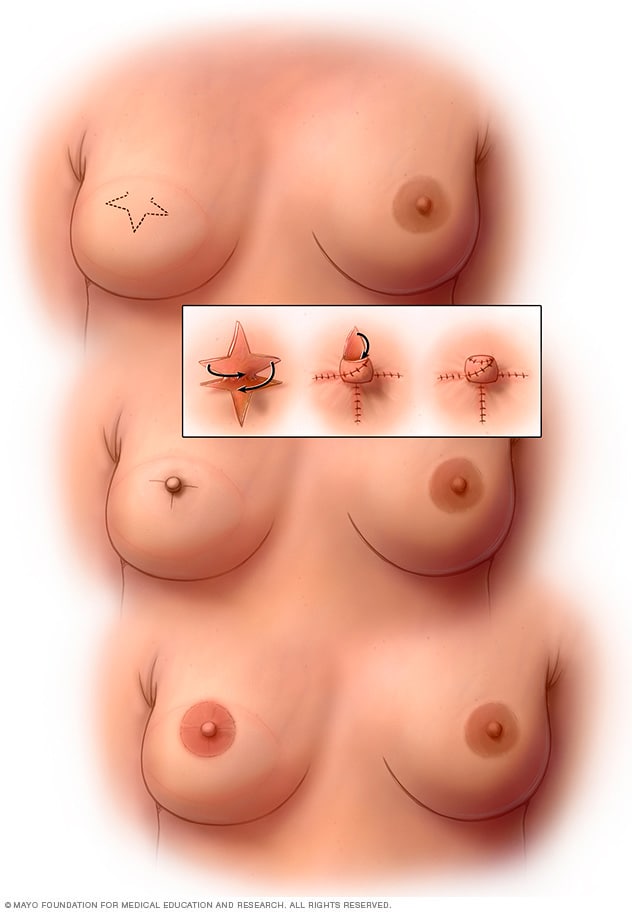
Illustrations of nipple reconstruction
Illustration of nipple reconstruction techniques using local skin flaps to create a raised nipple.
Breast reconstruction also may involve reconstruction of your nipple, if you choose. Surgery to make a new nipple is called nipple reconstruction. A plastic surgeon does nipple reconstruction most often after you've healed from the flap surgery. After the nipple heals, you may choose to have a tattoo to color the nipple and the circle of skin around it, called the areola.
Future breast cancer screening
If you have only one breast reconstructed, continue with mammograms for breast cancer screening on your other breast. You typically don't need mammograms on breasts that are reconstructed.
Continue to do breast self-exams on both breasts, including your reconstructed breast. Tell your healthcare professional about any changes you find.