Risks
Risks of breast biopsy include:
- Bruising and swelling of the breast.
- Infection or bleeding at the biopsy site.
- Scarring or skin changes, depending on how much tissue is removed and how the breast heals.
- Additional surgery or other treatment, depending on biopsy results.
Contact your healthcare team if you develop a fever, if the biopsy site changes color or becomes warm, or if you have unusual drainage from the biopsy site. These can be signs of an infection that may need treatment right away.
How you prepare
Before the breast biopsy, tell your healthcare professional if you:
- Have any allergies.
- Have taken aspirin in the last seven days.
- Are taking blood-thinning medicines.
- Are not able to lie on your stomach for an extended period.
If the breast biopsy will be done using an MRI, tell your healthcare professional if you have a cardiac pacemaker or other electronic device implanted in your body. Also tell your healthcare professional if you are pregnant or think you may be pregnant. An MRI may not be the best test in these situations.
What you can expect
Stereotactic breast biopsy
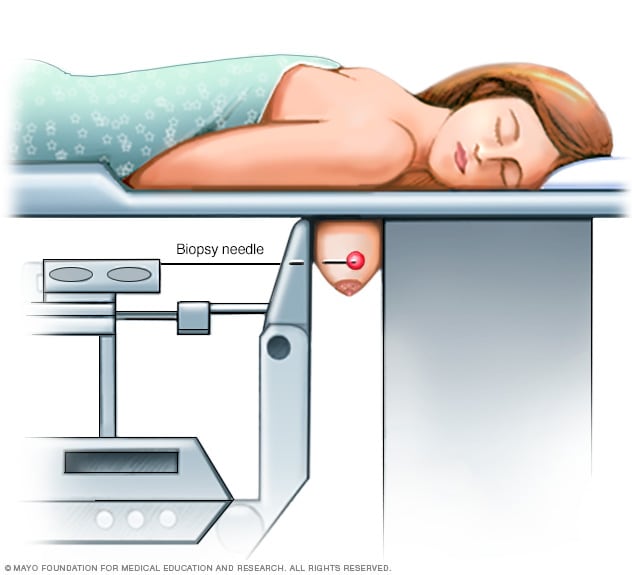
Stereotactic breast biopsy
During a stereotactic breast biopsy, the breast is firmly compressed between two plates. Breast X-rays, called mammograms, are used to produce stereo images. Stereo images are images of the same area from different angles. They help find the exact location for the biopsy. A sample of breast tissue from the suspicious area is then removed with a needle.
Before the procedure
You may be asked to remove some clothing or wear a gown for the breast biopsy. You also may be asked to remove jewelry, glasses or any other objects that could interfere with the procedure. Avoid wearing lotion, perfume, deodorant or powder under your arms or on your breasts on the day of the procedure.
During the procedure
Depending on the type of biopsy being done, you may sit in a chair or lie on a table, either face up or face down. If you're lying face down, your breasts hang freely through an opening in the table. Your breasts may be compressed and held in place throughout the procedure.
For many biopsies, you'll get an injection to numb the area of the breast being biopsied. For surgical biopsies, you'll be put in a sleeplike state.
Imaging tests such as ultrasound, MRI or X-ray may be used to help your healthcare team find the suspicious tissue. Once the area is located, a small incision is made in the skin to insert the biopsy needle. A vacuum-assisted device often is used to help remove samples of tissue. Most biopsy procedures take between three and 12 tissue samples for testing. If a surgical biopsy is being done, the surgeon will attempt to remove the entire breast mass.
A small metal clip usually is placed at the site of the biopsy. This helps the healthcare team find the area again if needed for future imaging tests, biopsies or treatments. These clips cause no pain and don't interfere with metal detectors, such as at an airport. The clips also don't interfere with future MRIs.
After a breast biopsy
With all types of breast biopsy except a surgical biopsy, you'll likely go home with only bandages and an ice pack over the biopsy site. The care team may tell you to take it easy for the rest of the day. Most people can resume their usual activities the next day.
Bruising is common after a breast biopsy. To ease pain and discomfort, a nonaspirin pain reliever may help. A cold pack applied to the area as needed may reduce swelling.
After a surgical biopsy, you may have stitches that will dissolve on their own. Wait 1 to 2 days before showering. Avoid exercise and putting the area under water for a week.
Results
After the biopsy procedure, the breast tissue goes to a lab for testing. The testing is done by a doctor who specializes in analyzing blood and body tissue, called a pathologist. It may be several days before the results of a breast biopsy are available.
The pathologist sends the results to your healthcare professional, who shares them with you. The results include the size and consistency of the tissue samples and the location of the biopsy site. The results also describe whether cancer, noncancerous changes or precancerous cells are present.
If you had a surgical biopsy, the results also show if the edges of the mass, called margins, are positive or negative for cancer cells. If cancer cells are present at the margins, you may need another surgery so that more tissue can be removed. If the margins are negative, then the cancer has been fully removed.
If the results of a biopsy differ from what is shown on a mammogram or other imaging test, another procedure may be done to confirm any findings.
If the results show that breast cancer is present, they include what kind of breast cancer you have. Your healthcare team uses this information to make a treatment plan.
Clinical trials
Explore Mayo Clinic studies of tests and procedures to help prevent, detect, treat or manage conditions.