Overview
Prostate gland
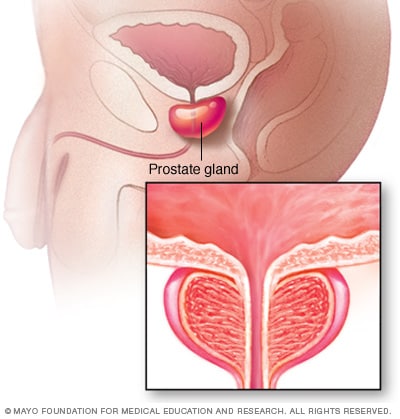
Prostate gland
The prostate gland sits just below the bladder. It surrounds the top part of the tube that drains urine from the bladder, called the urethra. The prostate's main job is to make the fluid that feeds and carries sperm, called seminal fluid. The prostate is part of the male reproductive system.
Laser photoselective vaporization of the prostate — also called laser PVP — is a minimally invasive treatment for an enlarged prostate. The procedure uses a laser to remove extra prostate tissue that's pressing on the urethra, which is the tube that carries urine from the bladder to the outside of the body. Laser PVP surgery is sometimes called Greenlight laser surgery.
During laser PVP surgery, a tube with a light and camera is inserted into the penis. This tool is called a cystoscope. A surgeon places a laser through the cystoscope to burn away extra prostate tissue that's blocking urine flow.
Unlike traditional prostate surgery, laser PVP surgery doesn't use cutting or scraping. This usually means less bleeding, which makes it a better option for people with blood-clotting conditions and those who take blood thinners.
PVP is one of many minimally invasive treatment options for an enlarged prostate, a condition known as benign prostatic hyperplasia. This condition also is called BPH. Like other minimally invasive treatments, PVP has a faster recovery than that of traditional prostate surgery.
Read more about benign prostatic hyperplasia, also called BPH, and prostate laser surgery.
Products & Services
Why it's done
Laser photoselective vaporization of the prostate, also called laser PVP, is a treatment for benign prostatic hyperplasia. This condition also is called BPH. BPH happens when the prostate gland gets bigger. Laser PVP surgery is done to help with urinary symptoms of BPH, such as:
- Feeling like you need to urinate often.
- Having trouble emptying your bladder completely.
- Having a slow or weak urine stream.
- Getting recurring urinary tract infections, also called UTIs.
- Getting up to urinate during the night.
A healthcare professional might suggest laser PVP surgery if you have an enlarged prostate and you:
- Can't fully empty your bladder.
- Have a history of UTIs.
- Have a history of stones in your bladder.
- Have blood in your urine that keeps coming back.
- Have kidney problems.
- Have tried medicines for BPH that didn't help.
- Have certain health conditions or take medicines that could make traditional prostate surgery riskier.
- Are at a higher risk of bleeding complications.
Risks
Laser photoselective vaporization of the prostate, also called laser PVP, is usually less risky than traditional prostate surgery. But complications can happen. Some risks of laser PVP surgery are:
- Bleeding. Bleeding may happen right after the procedure or later on. There is usually less bleeding after PVP laser surgery than after traditional prostate surgery.
- Difficulty urinating. This is common right after laser PVP surgery and usually gets better as you recover.
- Leaking urine. You may temporarily leak urine after laser PVP surgery.
- Feeling the need to urinate often. For a short time after surgery, you may feel like you need to urinate more often or more urgently.
- Infection. Urinary tract infections can happen after laser PVP surgery and may be treated with antibiotics.
- Retrograde ejaculation. Laser PVP surgery may cause semen to flow backward into the bladder during ejaculation.
- Urethral stricture. This is when the urethra — the tube that carries urine out of your body — is narrowed, usually by scar tissue.
There's also a risk that you may need a second procedure. A second surgery may be done to fix a complication from the first procedure. It also may be done to improve any symptoms that didn't get better.
How you prepare
Your healthcare professional may give you some directions to follow before laser photoselective vaporization of the prostate, also called laser PVP. You may:
- Stop some medicines. You may need to stop taking medicines such as blood thinners before laser PVP surgery. This is to help reduce the risk of bleeding during surgery.
- Get a physical exam. You'll likely have a physical exam to check your health and make sure you don't have any current infections. Your physical exam also may include a rectal exam. This helps your healthcare professional get an idea of your prostate size.
- Have tests or imaging. Your healthcare professional may order tests before laser PVP surgery. These tests might include blood tests, urine tests or other tests to check your bladder. To get a better idea of the shape, size and characteristics of your prostate, your healthcare professional may order imaging tests. Tests such as ultrasound, magnetic resonance imaging (MRI) or computerized tomography (CT) may be used to help plan your procedure.
- Talk about anesthesia options. Your healthcare professional may want to talk with you about the different types of anesthesia for laser PVP surgery. Usually, you have general anesthesia or spinal anesthesia.
What you can expect
Laser photoselective vaporization of the prostate, also called laser PVP, may be done in a hospital or surgery center. It's likely that you'll be able to go home the same day. But sometimes an overnight stay may be needed.
Before the procedure
You may be given an antibiotic before laser photoselective vaporization of the prostate, also called laser PVP. This is done to help prevent infection after surgery.
Your healthcare professional gives you either general or spinal anesthesia. General anesthesia puts you into a deep sleep, while spinal anesthesia prevents you from feeling anything in your lower body. With spinal anesthesia, you also may have medicines to make you relaxed and comfortable.
During the procedure
During laser photoselective vaporization of the prostate, also called laser PVP, a special tool with a light at the end is used to see inside your prostate. This tool sends out a beam of energy to gently melt away the extra prostate tissue that's pushing on your urethra. The urethra is the tube that carries urine from your bladder to the outside of your body. Your healthcare professional sweeps this laser along the inside of your prostate layer by layer until the blockage is gone.
After the procedure
Following photoselective vaporization of the prostate, also called laser PVP, you either go home the same day or spend one night in the hospital. You have a catheter to help empty your bladder. Your healthcare professional also may flush fluid through the catheter to clear any blood. The catheter is usually taken out within the first few days after laser PVP surgery.
It's common to have some urinary symptoms after laser PVP surgery. These symptoms may include:
- A burning feeling when you urinate.
- Blood in your urine.
- Feeling like you need to urinate often, which is usually temporary.
- Leaking urine.
These symptoms are usually part of recovery and get better as you heal. But it's important to let your healthcare professional know about any symptoms that bother you or get worse. Get medical help right away if you have lightheadedness, fever, chills or blood clots so thick that they block urine flow.
Results
Laser photoselective vaporization of the prostate, also called laser PVP, usually improves urinary symptoms caused by an enlarged prostate. Compared with traditional prostate surgery, laser PVP surgery offers benefits such as:
- A shorter hospital stay.
- Earlier catheter removal.
- Less bleeding during and after the procedure. This makes it a good option for people who take blood thinners or have blood-clotting conditions.
- Faster recovery.
Some symptoms may be better soon after laser PVP surgery, but you might not see the final results of the surgery for weeks or months. If your urinary symptoms don't improve or if they get worse, talk with your healthcare professional. Sometimes a second procedure may be needed.
Feb. 18, 2026