Overview
Jaw surgery, also known as orthognathic (or-thog-NATH-ik) surgery, corrects jawbones that are crooked, uneven or have other conditions. Surgery lines up the position of the jaws and teeth to make them work better. Making these corrections also may make your face look more balanced.
Jaw surgery may be a corrective option if you have a jaw condition that braces alone can't fix. Usually, you also have braces on your teeth before surgery and while you recover after surgery until healing and alignment are complete. Your orthodontist can work with your oral, jaw and face surgeon, also known as a maxillofacial surgeon, to figure out your treatment plan.
Jaw surgery is best done after growth stops. The timing is usually ages 16 to 18 and older for females and ages 18 to 21 and older for males. Other factors also may help determine the best timing.
Products & Services
Why it's done
Jaw surgery may help:
- Make biting and chewing easier and chewing better overall.
- Fix problems with swallowing or speech.
- Keep teeth from wearing out or breaking down.
- Fix bite fit or jaw closure issues, such as when the molars touch but the front teeth don't touch. This is known as an open bite.
- Make the face look more balanced when there is a small chin, underbite, overbite or crossbite.
- Make the lips better able to close fully and comfortably.
- Ease pain caused by temporomandibular joint disorder and other jaw problems.
- Fix facial injuries or birth defects of the face and jaw.
- Ease obstructive sleep apnea.
Risks
Jaw surgery is generally very safe when an experienced oral and maxillofacial surgeon does it, often planning and working with an orthodontist.
Risks of surgery may include:
- Blood loss.
- Infection.
- Nerve injury.
- Broken jaw.
- Return of the jaw to the original position.
- Problems with bite fit and jaw joint pain.
- Need for more surgery.
- Need for root canals on select teeth.
- Loss of part of the jaw.
After surgery, for a time you may have:
- Pain and swelling.
- Problems with eating. Taking supplements to get nutrition and talking with a dietitian can help with this.
How you prepare
An orthodontist usually places braces on your teeth well in advance of surgery. Braces usually stay on for 12 to 18 months to level and align your teeth ahead of surgery. Sometimes braces need to be worn for a longer time to "undo" tooth movements that were made before it was recognized that surgery was needed to fully correct jaw and teeth problems.
Rarely, surgery is done before orthodontic treatment. When this happens, braces are put on right before surgery, but this is rare.
Your orthodontist and oral and maxillofacial surgeon work together to create your treatment plan. X-rays, pictures and models of your teeth are part of the planning for your braces and jaw surgery. Sometimes, because of the difference in the way the teeth fit together, teeth need to be reshaped or covered with crowns, or both, to complete correction.
Three-dimensional CT scanning, computer-guided treatment planning and temporary orthodontic anchoring devices may help move teeth so you can spend less time in braces. If these efforts work well, sometimes jaw surgery isn't needed.
For best results, virtual surgical design and simulation may guide your surgeon to fit and correct the jaw position before doing the actual surgery. This process also may help show if more work, such as braces, will be needed after surgery to fix other fit differences in the teeth.
Virtual surgical planning also is used along with 3D printing to provide your surgeon with cutting guides and titanium plates to help make accurate cuts in the jawbones and position the jawbones in a highly precise manner during the surgery.
What you can expect
Before the procedure
Oral and maxillofacial surgeons do jaw surgery, usually with medicine that makes you sleep through surgery. Surgery takes place in a hospital. You may need to stay in the hospital for a couple of days or you may be able to leave the hospital the same day as your surgery. How long you spend in the hospital depends on the type of surgery and how complex it is.
During the procedure
Surgery usually can be done inside your mouth, so no facial scars show on your chin, jaw or around the mouth. Rarely, small cuts may be needed outside your mouth. If so, these cuts are placed where they're less likely to be seen and are often very small.
Your surgeon makes cuts in the jawbones and moves them into the correct positions. After your surgeon moves your jaw into place, tiny bone plates, screws and wires may be used to secure the bones into their new positions. Rubber bands are often attached to braces. The screws, which are smaller than a bracket used for braces, usually combine with the bone structure over time, but some may be removed later.
Sometimes extra bone is added to the jaw. To do this, your surgeon transfers the bone from your hip, leg or rib and secures it with plates and screws. Sometimes a bone graft can be taken from off-the-shelf bone grafts that don't require bone to be taken from elsewhere in the body. Sometimes the surgeon reshapes the bone for a better fit.
Jaw surgery may be done on the upper jaw, lower jaw, chin or any mix of these locations.
Upper jaw surgery
Upper jaw surgery
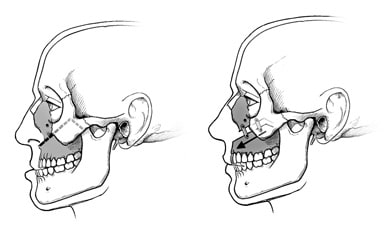
Upper jaw surgery
In upper jaw surgery, the surgeon makes cuts in the upper jaw; moves it forward, backward, up or down as needed; and secures it with plates and screws.
Surgery on the upper jaw, known as maxillary osteotomy, may be done to correct:
- An upper jaw that sinks in or sticks out too much.
- Crossbite.
- Too much or too little of the teeth showing.
- Open bite.
- A narrow upper jaw that's too small compared with the lower jaw.
- Reduced facial growth of the middle of the face, also known as midfacial hypoplasia.
Your surgeon cuts the bone above your teeth so that the whole top jaw, including the roof of your mouth and your upper teeth, can move as one unit. Your surgeon moves the jaw and upper teeth forward, backward, up or down until they fit properly with the lower teeth. In some cases, the surgeon can widen a narrow upper jaw during this surgery by making additional cuts through the roof of the mouth from the nose side of the upper jaw.
An open bite occurs when too much bone grows above the molars. This causes what's usually a flat, even surface to become angled. To fix too much bone growth, your surgeon shaves away or removes the excess bone.
Once your surgeon lines up the jaw, plates and screws hold the bone in its new position.
Lower jaw surgery
Lower jaw surgery
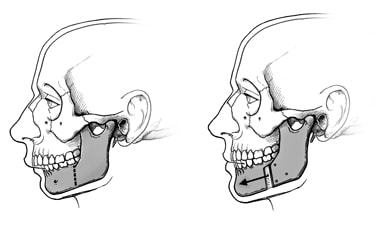
Lower jaw surgery
The lower jaw is divided and the front section is moved forward or backward and secured with plates and screws.
Lower jaw surgery, called mandibular osteotomy, can correct a lower jaw that sinks in or sticks out too much. The surgeon makes cuts behind the molars and lengthwise down the jawbone so the front of the jaw can move as one unit. Then the surgeon can move the jaw forward or backward to its new position. Plates and screws hold the jawbone together as it heals.
Chin surgery
Chin surgery
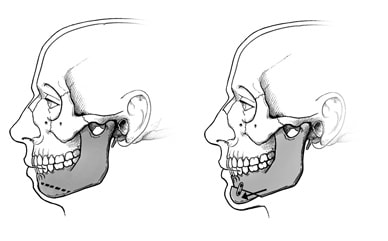
Chin surgery
In surgery to fix a small chin, also known as a genioplasty, the front part of the lower jaw is cut and that piece is moved forward and secured with plates and screws.
A chin surgery, also known as a genioplasty or an inferior border osteotomy, can correct a small chin, also called a deficient chin. A small chin often can occur along with a lower jaw that sinks in too much.
Surgeons usually can change the jaw and restructure the chin during the same surgery. The surgeon cuts a piece of the chin bone on the front of the jaw, moves it forward, and secures it in a new position with plates and screws.
After the procedure
After surgery, a healthcare professional gives you instructions. These instructions usually include:
- What to eat, such as foods in liquid form for a period of time followed by a diet that is soft and easy to chew.
- How to keep your mouth clean.
- Not using tobacco.
- Not doing activities or lifting that takes a lot of energy or effort.
- How to take medicines to control pain.
- When to return to work or school, which is usually in 1 to 3 weeks.
Initial jaw healing after surgery usually takes about six weeks, but full healing can take up to 12 weeks.
After initial jaw healing ― at about six weeks ― your orthodontist can begin further aligning your teeth with braces. The entire orthodontic process, including surgery and braces, may take several years. Once your orthodontist removes the braces, you may be given a retainer to hold your teeth in position.
Results
Correcting alignment of your jaws and teeth with jaw surgery can:
- Make your lower face look balanced.
- Make your teeth work better.
- Offer health benefits from improved sleep, breathing, chewing and swallowing.
- Improve speech if you had issues due to your jaw.
You also may be more satisfied with how you look, which can make you feel better about yourself.
Jan. 30, 2025