
Overview
Multiple sclerosis is a disease that causes breakdown of the protective covering of nerves. Multiple sclerosis can cause numbness, weakness, trouble walking, vision changes and other symptoms. It's also known as MS.
In MS, the immune system attacks the protective sheath that covers nerve fibers, known as myelin. This interrupts communication between the brain and the rest of the body. Eventually, the disease can cause permanent damage of the nerve fibers.
Symptoms of MS depend on the person, the location of damage in the nervous system and how bad the damage is to the nerve fibers. Some people lose the ability to walk on their own or move at all. Others may have long periods between attacks without any new symptoms, called remission. The course of the disease varies depending on the type of MS.
There's no cure for multiple sclerosis. However, there are treatments to help speed the recovery from attacks, modify the course of the disease and manage symptoms.
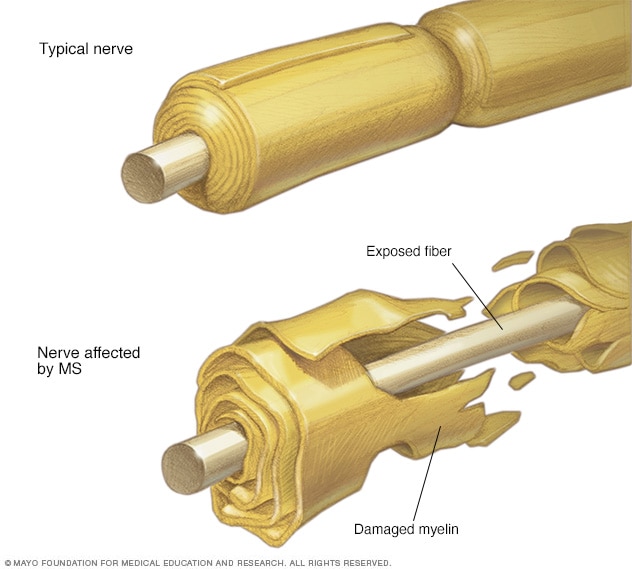
Multiple sclerosis
In multiple sclerosis, the protective coating on the nerve fibers is damaged and may eventually be destroyed. This protective coating is called myelin. Depending on where the nerve damage happens, MS can affect vision, sensation, coordination, movement, and bladder or bowel control.
Types
Some conditions are classified as stages, but multiple sclerosis is classified as types. MS types depend on the progression of symptoms and frequency of relapses. Types of MS include:
- Relapsing-remitting MS
-
Most people with multiple sclerosis have the relapsing-remitting type. They experience periods of new symptoms or relapses that develop over days or weeks and usually improve partially or completely. These relapses are followed by quiet periods of disease remission that can last months or even years.
- Secondary-progressive MS
-
At least 20% to 40% of people with relapsing-remitting multiple sclerosis can eventually develop a steady progression of symptoms. This progression may come with or without periods of remission and happens within 10 to 40 years of disease onset. This is known as secondary-progressive MS.
The worsening of symptoms usually includes trouble with mobility and walking. The rate of disease progression varies greatly among people with secondary-progressive MS.
- Primary-progressive MS
-
Some people with multiple sclerosis experience a gradual onset and steady progression of signs and symptoms without any relapses. This type of MS is known as primary-progressive MS.
- Clinically isolated syndrome
-
Clinically isolated syndrome refers to the first episode of a condition that affects the myelin. After further testing, clinically isolated syndrome may be diagnosed as MS or a different condition.
- Radiologically isolated syndrome
-
Radiologically isolated syndrome refers to findings on MRIs of the brain and spinal cord that look like MS in someone without classic symptoms of MS.
Symptoms
Multiple sclerosis symptoms vary depending on the person. Symptoms may change over the course of the disease depending on which nerve fibers are affected.
Common symptoms include:
- Numbness or tingling.
- Electric-shock sensations that happen with certain neck movements, especially bending the neck forward. This sensation is called Lhermitte sign.
- Lack of coordination.
- Trouble with walking or not being able to walk at all.
- Weakness.
- Partial or complete loss of vision, usually in one eye at a time. Vision loss often happens with pain during eye movement.
- Double vision.
- Blurry vision.
- Dizziness and a false sense that you or your surroundings are moving, known as vertigo.
- Trouble with sexual, bowel and bladder function.
- Fatigue.
- Slurred speech.
- Troubles with memory, thinking and understanding information.
- Mood changes.
Small increases in body temperature can temporarily worsen symptoms of MS. These aren't considered true disease relapses but pseudorelapses.
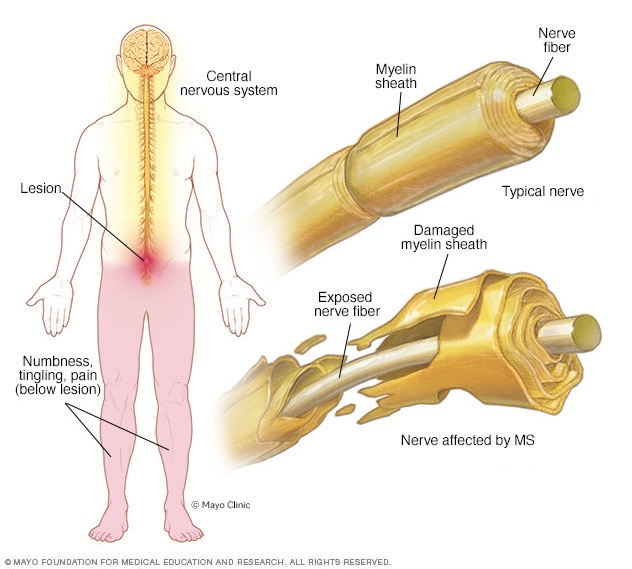
Myelin damage and the nervous system
In multiple sclerosis, the protective coating on nerve fibers, known as myelin, in the central nervous system is damaged. Depending on the location of the damage in the central nervous system, symptoms may happen, including numbness, tingling, weakness, visual changes, bladder and bowel troubles, memory troubles, or mood changes, for example.
When to see a doctor
Make an appointment with your doctor or other healthcare professional if you have any symptoms that worry you.
Causes
The cause of multiple sclerosis is not known. It's considered an immune-mediated disease in which the body's immune system attacks its own tissues. In MS, the immune system attacks and destroys the fatty substance that coats and protects nerve fibers in the brain and spinal cord. This fatty substance is called myelin.
Myelin can be compared to the insulation coating on electrical wires. When the protective myelin is damaged and the nerve fiber is exposed, the messages traveling along that nerve fiber may be slowed or blocked.
It isn't clear why MS develops in some people and not others. A combination of genetics and environmental factors may increase the risk of MS.
Risk factors
Factors that increase the risk of multiple sclerosis include:
- Age. MS can happen at any age. However, onset most commonly happens between 20 and 40 years of age.
- Sex. Women are 2 to 3 times more likely than men to have relapsing-remitting MS.
- Family history. If one of your parents or siblings has had MS, you are at higher risk of developing the disease.
- Certain infections. A variety of viruses have been linked to MS, including Epstein-Barr. Epstein-Barr is the virus that causes infectious mononucleosis.
- Race. People with white skin, particularly those of Northern European descent, have the highest risk of developing MS. People of Asian, African or Native American descent have the lowest risk. A recent study suggests that the number of Black and Hispanic young adults with multiple sclerosis may be greater than previously thought.
- Climate. MS is far more common in places with temperate climates. These include Canada, the northern United States, New Zealand, southeastern Australia and Europe.
- Vitamin D. Having low levels of vitamin D and low exposure to sunlight is linked to a greater risk of MS. Your birth month also may affect the chances of developing MS. This has to do with levels of sun exposure when a mother is pregnant.
- Obesity. People who are obese or were obese in childhood have an increased risk of multiple sclerosis.
- Certain autoimmune diseases. You have a slightly higher risk of developing MS if you have other autoimmune conditions. These may include thyroid disease, pernicious anemia, psoriasis, type 1 diabetes or inflammatory bowel disease.
- Smoking. People who smoke have a higher risk of relapsing-remitting MS than people who don't smoke.
- Gut microbiome. People with MS may have a different gut microbiome than people who don't have MS. More research is needed to understand this connection.
Complications
Complications of multiple sclerosis may include:
- Mood changes, such as depression, anxiety or mood swings.
- Muscle stiffness or spasms.
- Seizures, though they are very rare.
- Severe weakness or paralysis, typically in the arms or legs.
- Trouble with bladder, bowel or sexual function.
- Trouble with thinking and memory.