Overview
Intraoperative MRI
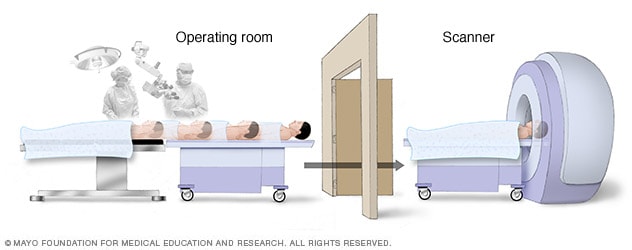
Intraoperative MRI
Since the brain can shift during surgery, brain-mapping techniques and intraoperative MRI are used to create accurate pictures of the brain. These images guide the neurosurgeon to remove only the tissue that needs to be removed and focus on the targeted region for therapy. This leaves functional brain tissue untouched. That helps preserve motor function, language and other important brain functions.
In computer-assisted brain surgery, surgeons use imaging tools to create a 3D model of the brain. The imaging may include magnetic resonance imaging (MRI), intraoperative MRI, computerized tomography (CT) and positron emission tomography (PET) scans. Specialized fusion software allows multiple types of imaging to be used. The imaging may be done before surgery and is sometimes done during surgery.
The 3D model lets the brain surgeon, known as a neurosurgeon, plan the safest way to treat the condition needing surgery. During the operation, a computer-guided system, called neuronavigation, shows the surgeon where to go. The system works like a GPS for the brain.
Sometimes the brain moves a little during surgery, which can change the original plan. To keep the guidance accurate, the team may use intraoperative ultrasound or intraoperative MRI to get updated images in real time during the surgery. These tools help the surgeon stay on the safest path even as the brain shifts naturally.
Other imaging tools may help the team avoid important areas of the brain that control movement, speech or vision. For example, some scans show active areas in the brain. In certain procedures, robotic tools may help keep the surgeon's hand steady or help guide a device into a very small space.
Together, these technologies help the care team plan each step of surgery and guide treatment with improved safety and accuracy.
Why it's done
Deep brain stimulation
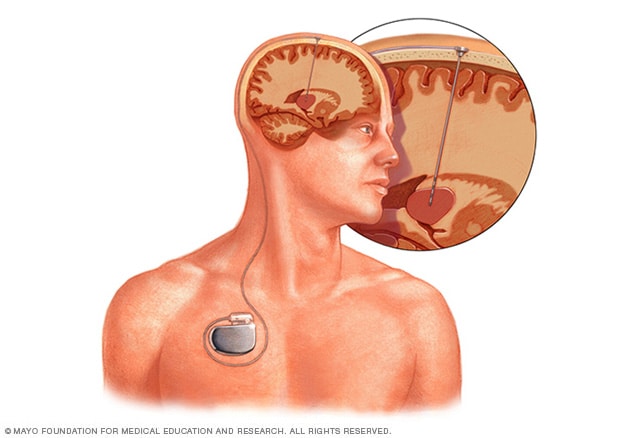
Deep brain stimulation
Deep brain stimulation involves implanting an electrode deep within your brain. The amount of stimulation delivered by the electrode is controlled by a pacemakerlike device placed under the skin in your chest. A wire that travels under your skin connects the device to the electrode.
Computer-assisted brain surgery is used to treat many conditions affecting the brain. These conditions include brain tumors, Parkinson's disease, essential tremor, epilepsy and arteriovenous malformations.
Your care team may use computer-assisted tools when the area needing treatment is close to parts of the brain that control important skills such as speech, movement and vision. These tools help plan the safest path to the problem area while lowering the chance of injury to healthy tissue.
If you have a brain tumor, your surgeon may combine computer-assisted surgery with awake brain surgery. This helps protect areas of the brain that control speech and movement.
Stereotactic radiosurgery
Computer-assisted technology is used during stereotactic radiosurgery, which delivers precisely focused beams of radiation. This treatment may be used for brain tumors, arteriovenous malformations, trigeminal neuralgia and other conditions.
Deep brain stimulation and responsive neurostimulation
Conputer-assisted tools may guide the placement of electrodes for deep brain stimulation or responsive neurostimulation. MRI or CT scans — or sometimes both — help map the brain and guide the positioning of the electrodes. Deep brain stimulation or responsive neurostimulation may be used for essential tremor, Parkinson's disease, epilepsy, dystonia or obsessive-compulsive disorder.
Biopsy
Computer-assisted systems are used when surgeons perform a stereotactic biopsy to remove a small tissue sample. The technology allows precise targeting, even when the area is deep in the brain.
Removing skull base tumors
Surgeons may use computer assistance during procedures on the skull base. These procedures may include removing tumors such as meningiomas or acoustic neuromas. These tumors sit near nerves and blood vessels, so accurate guidance is especially important.
Other therapies
Computer-assisted imaging also supports less-invasive treatments. For example, laser interstitial thermal therapy (LITT) uses MRI to guide a thin laser probe to the area needing treatment. This procedure may be used for some tumors or for epilepsy when other treatments have not worked.
Another option that doesn't involve making a cut is MR-guided focused ultrasound, which uses MRI to target a small point in the brain without making an opening in the skull. This treatment may help people with essential tremor.
These technologies also may help guide care during some blood-vessel procedures in the brain, such as treating aneurysms or planning a thrombectomy for a blood clot.
Risks
Computer-assisted brain surgery helps to lower the risks of surgeries. Creating a 3D model of your brain helps your neurosurgeon plan the safest way to reach the area that needs care. Computer assistance also helps guide your surgeon to the exact areas of the brain that need treatment. Still, every surgery has some risks.
Stereotactic radiosurgery
Stereotactic radiosurgery has few risks, and most side effects are temporary. Side effects may include feeling very tired or having soreness, swelling or irritation of the scalp at the treatment site. Rarely, brain changes may appear months after treatment.
Deep brain stimulation
Deep brain stimulation carries risks such as infection, bleeding, seizures or stroke. The device hardware also may need repair or replacement over time.
Laser therapy and focused ultrasound
Less invasive treatments also have risks. Laser interstitial thermal therapy (LITT) may cause temporary swelling, bleeding or irritation in the treated area.
MR-guided focused ultrasound may cause short-term numbness, balance problems or headache. In rare cases, some symptoms may last longer.
Craniotomy
A craniotomy is a type of surgery in which the surgeon removes a small piece of the skull to reach the brain. Risks may include bleeding, swelling or infection.
Navigation and imaging tools
Changes can happen in the brain during surgery, which may change the surgeon's view of the planned path for treatment. Updated images help keep the guidance accurate. Navigation tools and intraoperative imaging can help correct for this but may increase the time spent in the operating room.
How you prepare
Follow the instructions from your healthcare team about what to do in the days and hours before brain surgery. Your team explains the plan for your surgery and anesthesia, reviews your medical history and medicines, and tells you which medicines to stop or continue.
You may need to stop certain medicines before surgery. For example, blood-thinning medicines slow the blood-clotting process, which can increase the risk of bleeding. This includes aspirin, which is a blood thinner and should be stopped two weeks before surgery. Your healthcare team tells you whether you need to stop taking blood thinners and for how long.
If you are preparing for stereotactic radiosurgery, your team may ask you not to eat or drink for several hours before treatment and to bring a list of your medicines. Let your team know if you have an implanted device or allergies to contrast material.
If you are having deep brain stimulation or another computer-assisted procedure, you may need MRI or CT scans before surgery to help plan the exact path for treatment. Your healthcare team will explain how to prepare for the scans. You may be asked to remove jewelry and other metal objects. You might need to wear a hospital gown to help ensure clear images. Tell your care team about any implants or devices you have and about any allergies to contrast material.
What you can expect
What happens during computer-assisted brain surgery depends on the type of surgery you're having. A medicine that puts you in a sleeplike state, known as general anesthesia, often is used in computer-assisted brain surgery. If you're having awake brain surgery, you're given medicines that help you feel relaxed and block pain but that keep you awake. This allows you to interact with the surgery team to maximize safety during surgery.
During the procedure, your surgeon uses computer-guided tools that show your brain images on a screen in real time. This helps the surgeon follow the safest path to the area that needs treatment.
Your head may be gently supported so you stay in the correct position. The care team watches your heart rate, breathing and comfort throughout the procedure.
Sometimes a piece of skull is removed to operate on the brain. In other surgeries, such as stereotactic radiosurgery, no surgical cuts are made. Instead, radiation is aimed at the area of the brain needing treatment.
Your neurosurgeon may take imaging scans during surgery. These can include intraoperative MRI or CT using a portable CT scanner. The imaging machine may be in the operating room and brought to you when needed. In some hospitals, the machine is in a nearby room, and you may be moved briefly so the team can take updated images.
The updated images help the surgical team adjust the plan if the brain changes position during the procedure.
Results
Computer-assisted brain surgery helps surgeons more precisely plan and conduct brain surgeries. When brain surgery is more precise, it leads to better outcomes and fewer complications.
Using imaging during surgery, known as intraoperative MRI or CT, helps neurosurgeons see changes to the brain that occur during surgery. For example, the brain can shift during surgery. Taking images during surgery helps to make the surgery more precise. Intraoperative imaging also alerts surgeons to complications so that they can be addressed quickly.
Intraoperative MRI also has been shown in some studies to increase the chances of complete tumor removal, when it can be done safely. This can be especially important for tumors located near areas of the brain that control speech, movement or other key functions.
Computer-assisted surgery helps the surgeon treat only the area that needs care and stay away from healthy brain tissue. This helps protect important skills such as speech or movement.
Sept. 16, 2026